The Award Winning Innovation Redefining Workforce Participation in Western Australia




Western Australia’s labour market is approaching a critical point. While the state’s care and community services sectors continue to experience sustained workforce shortages, thousands of parents who are highly motivated to work remain unable to participate in employment due to barriers that have nothing to do with aspiration and everything to do with access.
Bridging that gap is rapidly becoming an economic imperative. And it is the gap Anglicare WA set out to address through Hopscotch, a place-based pre-employment pathway co-designed with parents of young children with experience of exclusion from the workforce.
Hopscotch was developed by Anglicare WA’s innovation team, ShiftLab. ShiftLab addresses emerging social and economic trends affecting Western Australian families by collaborating with communities and external partners to design practical, forward-looking solutions. Its approach embraces uncertainty through experimentation, learning and adaptation, creating connected responses that build on each other and generate evidence to strengthen systemic advocacy.
ShiftLab’s research identified a contradiction that industry already feels: the state needs more workers, particularly in the care economy, yet there is a significant pool of parents, especially single parents, who want to work but face entrenched structural barriers that limit their opportunities. As shared by a Hopscotch participant, “I don’t want to rely on other people. I want to set a good example for my kids.”
Hopscotch started with a question: “How might we design pathways into work that are built around family life, removing systemic barriers so parents can participate on their own terms?” Rather than designing a theoretical solution, the ShiftLab team listened to parents about what they need to return to the workforce. The answers were clear and consistent: childcare access, transport, financial strain, low confidence, and the cost and intimidation of retraining made employment practically out of reach. For these parents, the issue was not motivation but a system that made participation unfeasible.
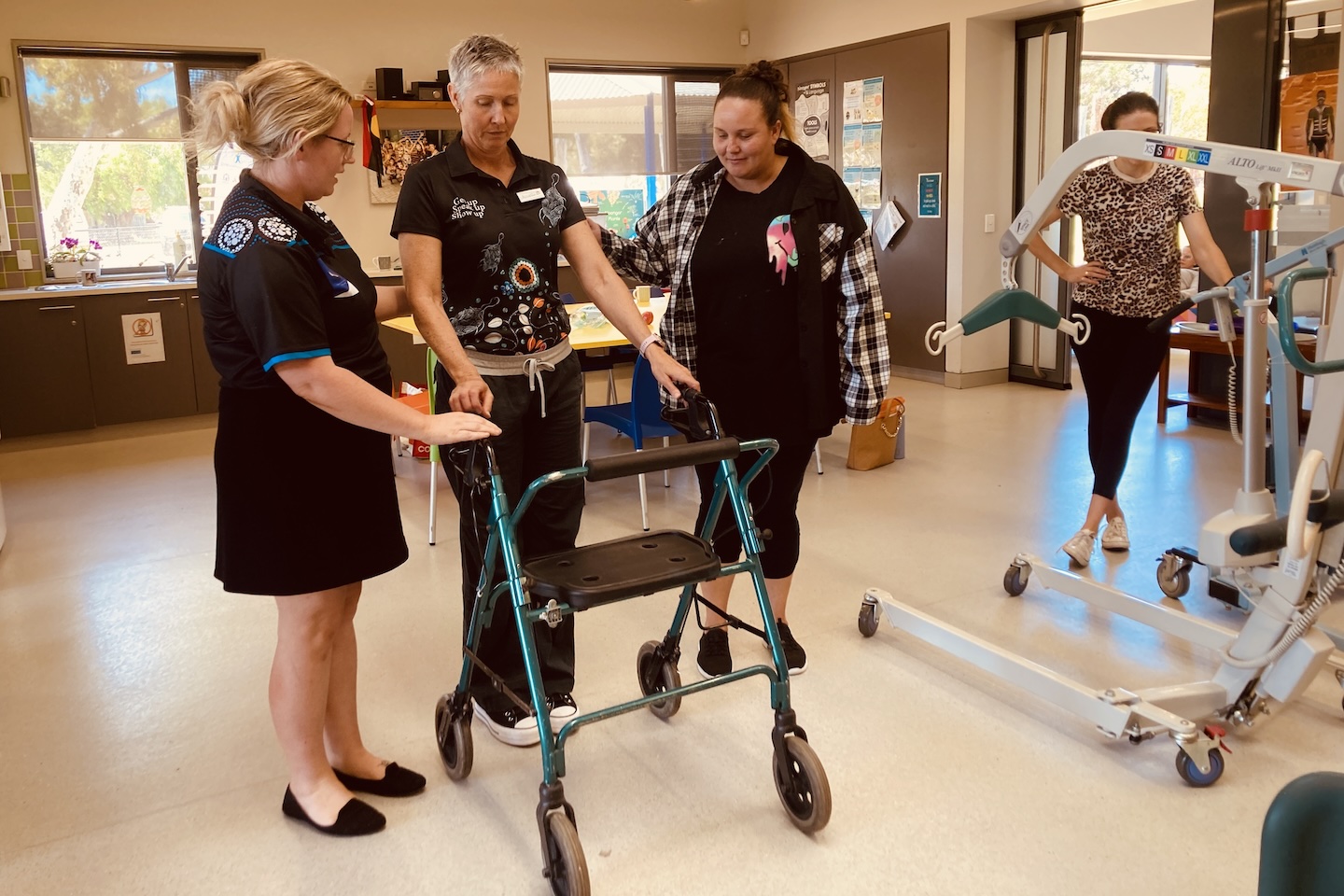
Hopscotch’s model removed those obstacles one by one. The program included an on-site creche, transport assistance and daily financial relief with a $50 voucher. The training pathway, a community support skillset of three units comprising personal support, first aid and communicating at work acted as a soft entry point to work or further study in the community or care sectors. Beyond training, the program delivered something often overlooked in traditionally funded employment models: wrap-around family support and a trauma-informed approach to rebuilding confidence, routine and identity.
The program operated in Mandurah through the Dudley Park Child and Parent Centre run by Anglicare WA, a space trusted by local families co-located with a primary school, making it easy to access post school drop off. The inaugural cohort achieved a 100 per cent completion rate. Participant confidence increased by 61% from intake to exit. Graduates reported reduced social isolation, expanded community connection and a sense of being imminently employable. For many, the impact was personal as well as economic. As one participant put it, “Hopscotch gives a great opportunity to parents to gain skills and confidence to get back into the workforce. After you have children, you can lose a bit of yourself. This is such an important program to allow parents to get that confidence back in relation to work and financial freedom.”
A major factor behind Hopscotch’s success was its partnership model. More than 20 Western Australian organisations including Community Skills WA, Dress for Success and Foodbank contributed referral pathways, work experience placements, services and expertise, earning the program the Anglicare Australia Excellence in Partnership Award. The collaborative approach demonstrates the role partnerships can play in solving workforce challenges at scale.
Hopscotch also arrives at a moment when WA labour dynamics are under scrutiny. According to government data, more than 90,000 Western Australians are on JobSeeker Allowance, with over 26,700 receiving Single Parenting Payment. Meanwhile, the care and community workforce is expected to grow substantially over the next decade to meet the needs of an aging population. Matching those figures is not simply a social goal, it is an economic imperative.
Anglicare WA Acting Innovation Design Manager, Kira Rikkers, tells the data should prompt confidence rather than pessimism. “For the past two years I’ve been sharing insights from Hopscotch across the sector and with all levels of government, and what I want people to feel is relief. There are solutions. There are ways forward. ShiftLab is committed to sharing what has been learned through Hopscotch with anyone interested in applying the approach. The insights and evidence generated are available to inform sector practice and policy. When we design systems around people rather than expecting people to bend to systems, barriers that once seemed insurmountable start to fall.”
The program has completed its initial innovation phase and generated insights that are already informing sector practice and policy. Early case studies have been presented to Workforce Australia as part of the national redesign of employment services. The demand from parents remains strong and employers are still calling for workforce solutions that can be activated now, rather than five or ten years from now. Hopscotch offers a proven, people-centred pathway that connects untapped talent with industries in need. Hopscotch is, at its core, about creating fair and practical pathways for parents who want to work but are blocked by structural barriers. It responds to real needs: childcare, transport, confidence, and the cost of retraining; while offering a pathway into industries that need workers, building skills that align with WA’s demographic trajectory, and expanding opportunities for families to achieve economic stability. It also demonstrates something increasingly relevant to business and government decision makers: sometimes the most effective workforce strategy is not to search harder for talent, but to redesigning systems so talent can step forward.
As the state looks towards long term workforce planning, there is an opportunity for partners and funders to build on these learnings and explore what scaling could look like. Hopscotch offers more than a case study, it provides a blueprint for ways in which systems can adapt to people so everyone can live a good life.
Charitable Organisations
| 9th | - | Clontarf Foundation | $84.59m |
| 10th | - | Autism Association of Western Australia | $83.87m |
| 11th | - | Anglicare WA | $83.20m |
| 12th | - | Uniting WA | $82.90m |
| 13th | - | Rise | $62.07m |