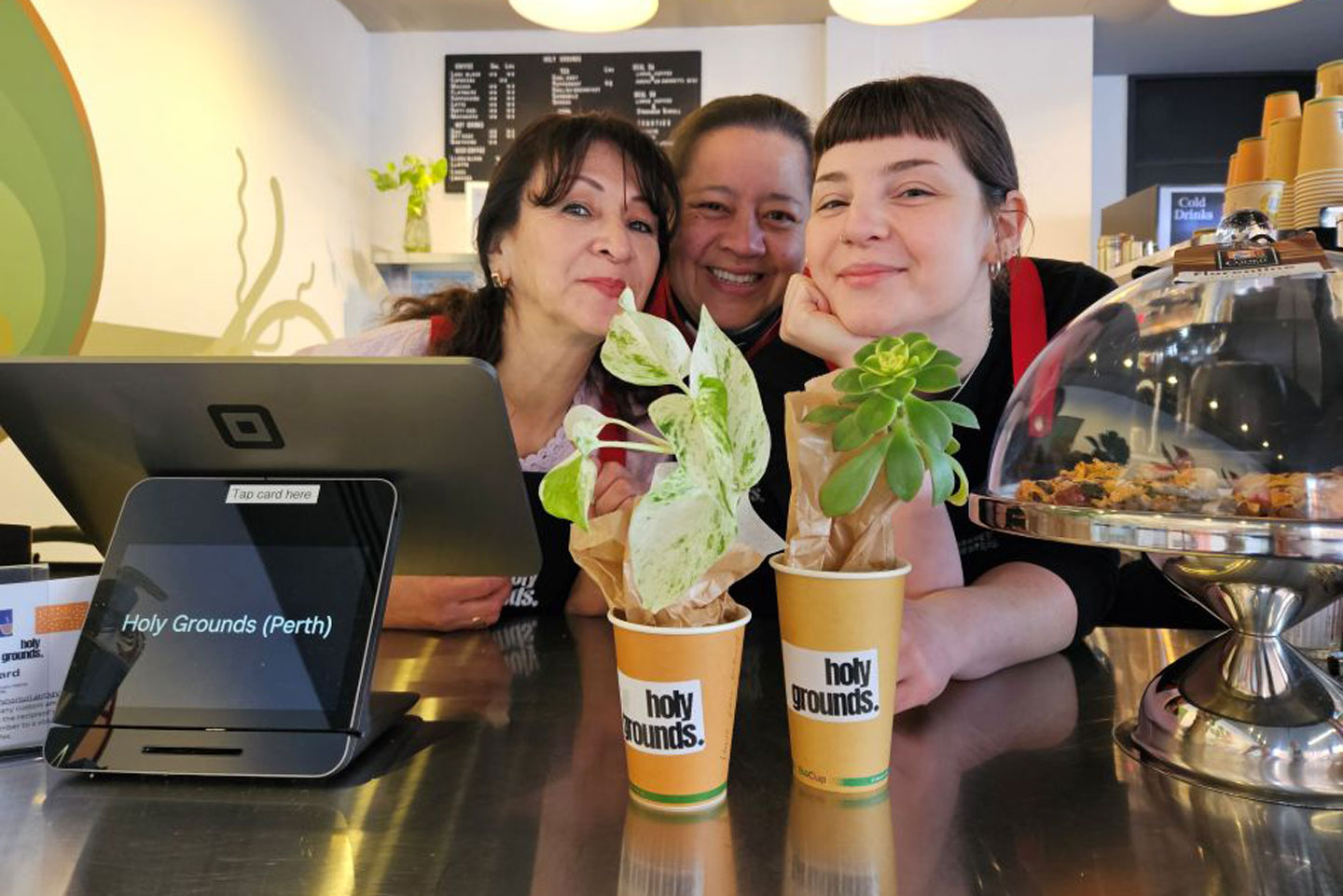
Holy Grounds did not begin as a grand social program or a heavily funded urban initiative. It began with a simple observation, most people buy a coffee every day, yet many still feel profoundly alone. From that small insight grew a café and hub that now sits in Cathedral Square with a purpose far larger than its footprint suggests.
On the surface, Holy Grounds looks like any other inner-city café , but behind the counter, the transaction carries an additional layer of meaning. Each coffee sold does more than cover beans and barista wages; it quietly contributes to a network of volunteers, activities and shared experiences designed to bring people into conversation.
The initiative was born from conversations between Anglicare WA and St George’s Anglican Cathedral, organisations accustomed to seeing the downstream effects of disconnection long before it becomes a public talking point. For Anglicare WA in particular, the issue is not abstract. Loneliness is rarely the headline problem, but it is often the precursor. The quiet condition that sits behind mental-health struggles, housing instability and social withdrawal.
A generous bequest in 2024 was the catalyst for bringing the idea to life. Since opening its doors in October 2024, Holy Grounds has become something more layered than hospitality. It operates as a social enterprise built on a simple equation, sell coffee, fund connection. Investing in a space that encourages belonging before crisis emerges is in many ways a preventative strategy disguised as hospitality.
Step inside on any weekday morning and the atmosphere feels closer to a neighbourhood living room than a commercial venue, conversation starters are written on takeaway cups, a communal puzzle waits mid-progress on a table, laptops share space with knitting circles, and strangers exchange greetings that quickly soften into familiarity
At the centre of this ecosystem is community coordinator Chrissy Wilson, whose focus is sustainability rather than charity. “Holy Grounds is not positioned as a handout, but as a self-sustaining model where daily trade underwrites social good. The objective is viability through participation, the more the café is used, the more it can give back”.
The numbers tell part of the story with more than thirteen thousand coffees sold since launch, served by two dozen active volunteers, however the more meaningful outcomes are less obvious on the surface. Volunteers who arrived shy now lead workshops, patrons who once sat alone now meet friends without arrangement. At any point in the week you will find people using the tables for support groups, crafting, board games, work experience opportunities and more. The space has become less about caffeine and more about confidence.
Even the coffee itself carries an unintended metaphor. Holy Grounds serves “Dark Horse,” a Western Australian blend that mirrors the café’s own trajectory. Modest at first glance, it consistently exceeds expectations. In a hospitality landscape often defined by margins and trends, Holy Grounds measures success differently, not just in revenue, but in return visits, new friendships and the conversation that fills the room.
What Holy Grounds ultimately challenges is the narrow definition of what a café is meant to do. Urban development tends to prioritise physical infrastructure including roads, rail lines, commercial precincts, while the quieter architecture of community is left to chance. Holy Grounds demonstrates that social infrastructure can be built into everyday spaces. It does not require grand gestures or government mandates; sometimes it begins with tables placed close enough to encourage dialogue and a cup designed to start it.
“For the community, by the community” is not branding here; it is operational truth” Says Wilson. The café exists because people choose to show up , to volunteer, to host activities, to buy a coffee not only for themselves but for the space it sustains. Commerce and compassion are not treated as opposing forces, but as complementary ones.
What started as an idea has become a working example of how small, intentional spaces can shift the emotional landscape of a city. Holy Grounds is redefining what a café can be, not merely a stop between meetings, but a place where everyday transactions quietly fund belonging, where conversation is considered essential infrastructure, and where community is brewed one cup at a time.
So the next time you find yourself buying a coffee in the Perth CBD, pause for a moment and choose a cup that carries a little more meaning. At Holy Grounds, that everyday habit becomes an opportunity to spark connection, support community, and quietly contribute to something bigger than a caffeine fix.
https://www.holygrounds.org.au/donations


 By Hearts and Minds