TERRY Butler-Blaxell learned of Fortescue’s plans to develop a $950 million renewable energy hub on Strelley Station from news reports.
The chairman of Nomads Charitable & Education Foundation, which manages the Strelley community, Mr Butler-Blaxell is mostly complimentary of Fortescue’s relationship with the station and its Indigenous communities.
Announced in April, that 200-megawatt project, which insiders claim has potential to scale to six gigawatts, has been pitched as a decarbonisation option for data centres and other industrial proponents in the Pilbara.
The Nyamal Aboriginal Corporation, whose lands the project sits on, was similarly surprised by the announcement.
Further east, pastoralists watching Fortescue map out major energy assets on their stations are fed up with the miner’s behaviour.
And it isn’t just traditional owners or pastoral circles rushing to get a read on Fortescue’s rapid green energy rollout.
Fortescue’s use of the Mining Act to pursue green power projects has pushed the Andrew Forrest-led miner close the edge of the law.
If Fortescue is permitted to power other industries using energy generated under the Mining Act, the state government risks handing the mining company a competitive advantage over other energy proponents.
Such a concession could hamper the government’s desire to build a common-user grid, according to Owen Hightower, managing director of regional advisory firm RFF Australia.
“Hypothetically, there could be a two-tiered energy system where the common-user grid goes ahead, if it can get legs,” Mr Hightower told Business News.
“But there’s a separate energy market operating under the Mining Act where proponents are entering into power-purchase agreements to sell their surplus energy to other mining operators.
“The consequence of that is it potentially diminishes the business case for the large-scale common-use infrastructure that might be needed to power our strategic industrial areas.
“The common-user network becomes largely reliant on speculative projects rather than certainty of demand from any business that was in the market looking to decarbonise.”
For its part, Fortescue wants to avoid a lengthy approval process through the Land Administration Act, given Mr Forrest has pledged to turn-off everything still running on fossil fuels in 2030.
“Fortescue has applied for mining tenure to support the timely development of renewable energy infrastructure required for its mining operations,” a Fortescue spokesperson said.
“The Mining Act provides the most appropriate and efficient framework to enable this development.”
Business News asked Energy Minister Amber-Jade Sanderson if she was concerned about the viability of a common-user grid in the Pilbara, and whether the state would allow energy generated under the Mining Act to power non-mining infrastructure.
Those questions were not answered.
Grand plans
Since 2024, Fortescue has undertaken an extensive green energy rollout to provide its power needs.
In March this year, Fortescue’s public rhetoric changed: the miner was now talking about selling power to third parties.
First it was other miners, with lithium miner PLS Group emerging as a potential buyer.
A month later, Fortescue revealed its desire to plug other industries into its network.
“We are now extending this model to new customers, particularly data centres, helping meet one of the fastest-growing sources of demand in the world,” Mr Forrest told the ASX in April.
Several sources have told Business News Fortescue’s desire to power other miners is likely permissible under the Mining Act.
Less clear is the Act’s limits when it comes to powering non-mining industries.
This is the limit Fortescue appears set to test.
Fortescue did not answer how its understanding of the Mining Act led it to believe it could power non-mining infrastructure.
Nor did the miner answer whether the data centres it spruiked as potential customers in April would be third-party companies or built by Fortescue.

Troy Eaton’s Nyamal country is home to several of Fortescue’s green energy projects. Photo: Tom Zaunmayr
Fortescue also did not answer if it believed the Mining Act should be changed to allow it to feed excess power to a common-user grid.
Ms Sanderson did not provide an answer when asked whether powering data centres with energy generated by a Mining Act project should be permissible.
Ground rules
Using a miscellaneous licence via the Mining Act, a company can build infrastructure crucial to mining operations.
The Act covers transport, utilities and site facilities used only for mining.
That caveat is in place to limit the extent to which companies building infrastructure under the Mining Act can compete in the market.
Projects built using miscellaneous licences under the Mining Act are exempt from local government rates, pay minimal land lease fees, and do not need to make deals with pastoralists or native title bodies (though they are encouraged to).
An example would be accommodation, which, if built under the Mining Act, cannot lure tourists away from hotels or caravan parks that pay council rates.
The term ‘mining-related’ could theoretically open doors to a broad suite of uses.
Mr Hightower said some clarity around that grey area would be beneficial.
“Hypothetically, we could be building a whole bunch of households in the Pilbara under the Mining Act, because the economy is largely mining-related,” he said.
“When the primacy of the land use changes, or the scale and significance of the land use is different to the actual mining purpose itself, to me, that would be when further questions should be asked about whether the tenure being sought is the right type of tenure for the project.”
Pastoral pinch
Strelley Station is leased by the Indigenous descendants of the 1946 Pilbara strike and run by Nomads Charitable & Education Foundation.
Fortescue’s latest energy project could render 30,000 hectares of the 450,000ha property on Nyamal country unusable for pastoralism.
“It is a curious use of the Mining Act,” Mr Butler-Blaxell said.
“Other renewable energy projects that don’t have mining companies behind them would use a different form of tenure under the Land Administration Act, and that would trigger various processes, like a right to negotiate with a native title party.
“A miscellaneous licence gets a comment from the native title party, and like any form of mining tenement that affects a pastoral lease, there’s no automatic entitlement to compensation.
“It is up to the parties to negotiate in good faith, and that’s my expectation. But there is no requirement to reach an agreement before these tenements get granted.”
Mr Butler-Blaxell believes Fortescue will come good on negotiations, noting the miner and Nomads had coexisted well for 15 years.
Pastoralists to the east of Strelley are not so optimistic.
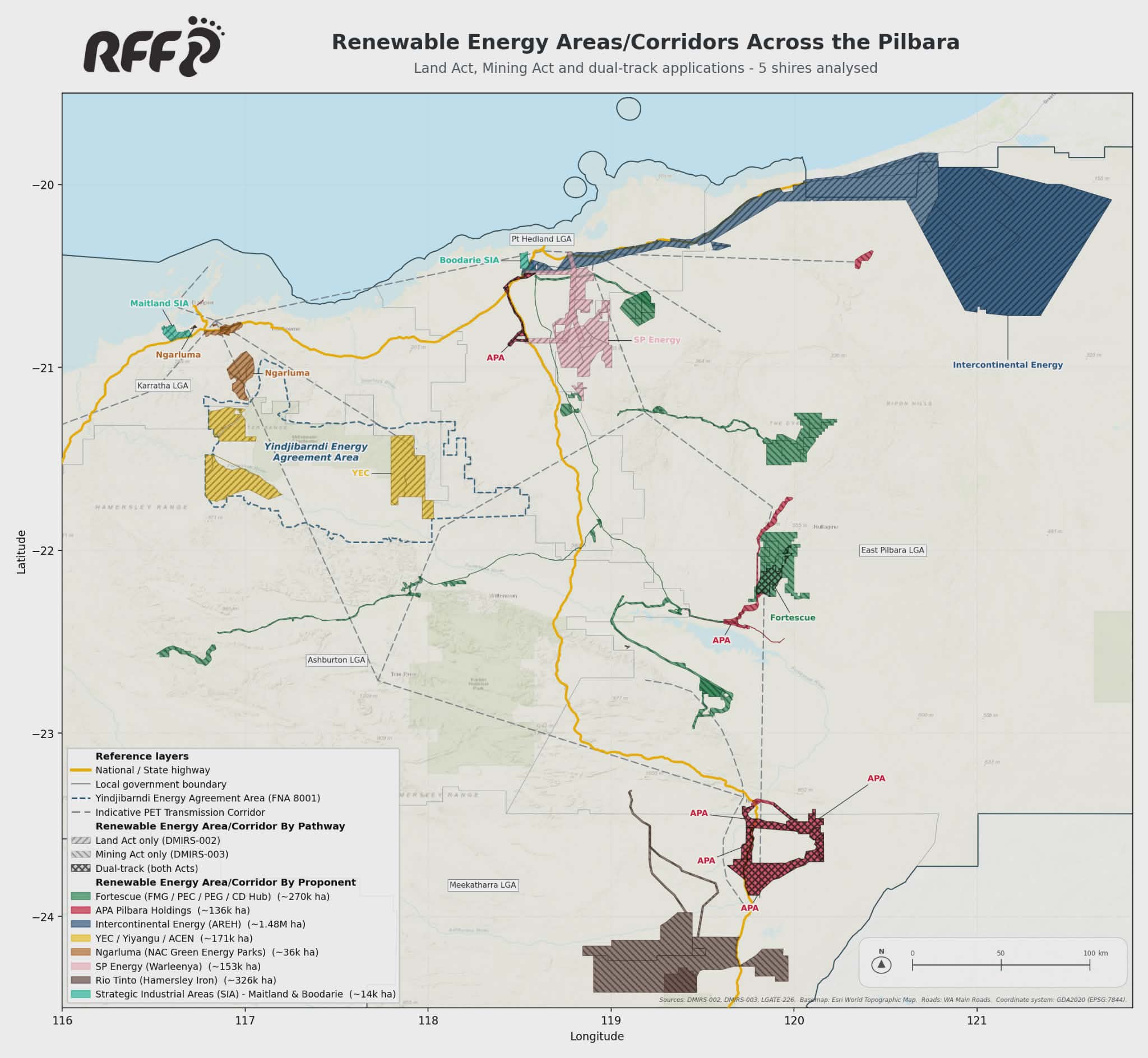
Fortescue has earmarked a 90,000ha development envelope for the Bonney Downs wind farm under the Mining Act; about one sixth of the Bonney Downs and Corunna Downs leases.
Business News understands Fortescue’s proposed wind turbines would encroach on Bonney Downs’ main paddock near the homestead, and that the spread of turbines would make aerial mustering, which is essential in the remote locale, close to impossible.
The station was contacted for comment.
The Bonney Downs project has also been subject to a boundary-line scrap in the Wardens Court with Alinta Energy over what is now APA Group’s Chichester energy hub.
In fact, more than 30 matters were listed to be heard at the Wardens Court in April and May featuring Fortescue’s power subsidiary, Pilbara Energy, with Alinta Energy, BHP, Hancock Prospecting and a host of small companies on the other side of the table.
Brent Smoothy of Hillside Station is preparing to add his grievances about Fortescue’s transmission lines to that list.
“One will cut the property in half, which is approximately 55 kilometres, and we have another one … which is 50 kilometres and will cut one side of our property off altogether,” Mr Smoothy told Business News.
“We are 100 per cent reliant on aviation to muster our cattle, and it takes away our ability to muster them.
“If Andrew Forrest thinks he’s the Man from Snowy River, he can come and muster it.
“Put his guys on it, because if [Fortescue] ran their risk matrix on it, they would say there is a risk of a fatality and they wouldn’t proceed.”
Mr Smoothy said he relied on public information to know what Fortescue was doing on his station.
Rights, benefits
Some of the friction boils down to who benefits from Fortescue’s renewable energy projects.
Elsewhere in the North West, equity or benefit-sharing arrangements have been struck between traditional owners and renewable energy proponents.
One clear beneficiary of the Mining Act pathway is the developer. In this case, Fortescue.
Mr Hightower said the certainty afforded under the Mining Act was crucial to attracting investment.
“In some circumstances, I would expect that mining organisations developing energy infrastructure under the Mining Act already have holistic agreements with native title parties that can be utilised to fast-track development,” he said.
“When those agreements were signed, I don’t expect many people ever contemplated those types of agreements being utilised to develop energy infrastructure that in some cases will have a significantly greater development footprint than the mines themselves.”
For pastoralists, a lack of obligations to include them in discussions has left the sector nervous about the viability of their businesses.
Mr Smoothy said other companies operating on Hillside Station were a blueprint of how Fortescue should behave.
“The likes of Atlas Iron [Hancock Iron Ore], which is owned by Gina Rinehart now, and [its] rail line that runs through our property, they are no problem whatsoever to deal with,” he said.
“They are quite happy to sit down here and negotiate and work out what’s best for each side.
“We are not against progress whatsoever. Mining is a part of Western Australia. All we are asking for is safety to come first.”
Business News understands Fortescue’s Nullagine wind project has caused some level of consternation among the Palyku people as well.
Palyku-Jartayi Aboriginal Corporation declined to comment.
Nyamal Aboriginal Corporation co-chairman Troy Eaton only learned of the Pilbara Green Energy Project’s approval when he was contacted for this story.
He said Nyamal generally had a good relationship with Fortescue but that the miner had 'gone behind the back' of his people on the Pilbara Green Energy Project.
“Fortescue developed many of their mines without Traditional Owner consent or pursuant to agreements with false promises in relation to partnerships,” he said.
“They cannot repeat this and need to get Traditional Owner consent for their large-scale renewable energy projects
“It is not appropriate to use mining ancillary tenure processes in legislation and in native title agreements to go around the back door and get renewable energy tenure and approvals granted.”
A Fortescue spokesperson said the company wanted its project to deliver economic benefits to the Nyamal people.
"Fortescue always has and always will work closely and respectfully with the Nyamal people. Our Iron Bridge operations are on Nyamal country and operate pursuant to a negotiated agreement," they said.
"The board’s approval allows the project to move into the next stage of development, with further engagement, cultural heritage work and regulatory approvals a part of that process.
"We’ve always believed that major projects should create lasting opportunities for local communities and First Nations people.
"That is something we have demonstrated over many years through our Billion Opportunities program, which has delivered billions of dollars in contracts to First Nations businesses across Australia and helped create jobs, grow businesses and build long-term economic participation."
Policy stasis
Government policy has not kept up with Fortescue’s rapid green deployment, according to those interviewed for this story.
A state government spokesperson said future tenure opportunities were being considered for renewable energy in the Pilbara.
“The appropriate tenure pathway for proponents seeking to develop common-user energy infrastructure in the Pilbara is the Land Administration Act 1997,” they said.
“A dedicated team has been established within the Department of Planning, Lands and Heritage to prioritise and expedite the assessment and grant of LAA tenure for priority transmission corridors in the Pilbara.”
Mr Hightower said any changes to land tenure laws needed to create a level playing field for green energy proponents.
“If we are going to unlock and diversify the Pilbara’s economy, and we are going to create industrial areas that have access to meaningful, cheap power … then the pathway that all [energy] proponents should be getting told to pursue ... is under the Land Administration Act,” he said.
“Proponents who followed the government’s direction to pursue the development of energy infrastructure based on the Pilbara Energy Transmission Plan [through the Land Administration Act] … have as a consequence incurred much greater development costs and barriers to entry for their projects.
“If someone else was able to shortcut that through a Mining Act arrangement, then certainly I think that would undermine investment that has been put into those other projects, and investment more broadly.”
Without that, Mr Hightower said there was a risk proponents could use the Mining Act to fast-track their projects with an eye to changing land tenure once the infrastructure was built.
That, he said, could cause friction with native title parties and pastoralists, and with other energy proponents.
For pastoralists, a better system for engagement and compensation is front of mind.
“The state government needs to be ever-vigilant about how tenure is approved and what it is going to be used for,” Mr Butler-Blaxell said.
“This use of miscellaneous licences for a regional scale generation project that’s 50 to 60 kilometres away from the nearest mining operation … there are probably other forms of tenure that are better suited to this process.
“It is puzzling, using the miscellaneous licence for something that doesn’t seem directly related to a mining project.”
Fortescue did not answer what it believed needed to change with the Land Administration Act for the miner to use it.