A true believer in the economic might of innovation and technology, arcade games billionaire Malcolm Steinberg is certainly one to put his money where his mouth is.
Not only has he spent nearly $20 million funding education in entrepreneurship and seeded Western Australia’s first independent venture capital fund with $12 million, he has also backed a long-term employee to drive a revolutionary new approach to the games sector that made his fortune.
The founder of Timezone and a host of related businesses, Mr Steinberg now has a warehouse full of arcade games hooked up to the internet via cameras for users to play under a new and fast-growing business called ArcadeXR.
Business News met ArcadeXR founder and chief executive Shannon Perell with Mr Steinberg and his son, Adam Steinberg, who runs the family’s private business, LAI Group, at their Osborne Park premises.
Behind the façade of LAI’s nondescript industrial building lies an intriguing intersection of the old and the new: dozens of beeping, buzzing and jangling machines rigged up with cameras being played by customers the world over.
While the two-year-old ArcadeXR is in its infancy, Mr Steinberg highlights how much it reflects his belief that entrepreneurs adopting technology could replace mining as the major economic driver in WA in the not-too-distant future.
The Timezone arcade business he now half-owns with a private equity partner is competing in the physical side of the global games industry worth about $25 billion.
The capital required to grow through an expanding footprint of outlets and machines is considerable in a sector that is mature and dominated by major, muscular competitors.
By comparison, ArcadeXR is aiming at the $100 billion mobile gaming market: far larger, much newer and very much more fragmented.
It’s a point Mr Steinberg stresses: that technology businesses have easier access to bigger markets and, if the right idea is managed well, can generate growth at a speed regular businesses can only dream of.
He compares the scale and duration of mining’s success stories with the relatively overnight success of major technology businesses.
At a global level, the market capitalisations of resources giants BHP and Rio Tinto (both established in the 19th century) are dwarfed by the leading technology stocks colloquially referred to as the ‘magnificent seven’ – Apple, Microsoft, Amazon, Meta, Alphabet, Nvidia and Tesla – the oldest of which started in 1975.
Mr Steinberg’s well documented backing of entrepreneurialism, both in education and through venture capital, is part of an orchestrated campaign to drive new business development in WA to offer a significant alternative to resources for founders and investors.
Operating through his Steinberg family office and philanthropic venture, Malka Foundation, Mr Steinberg has become the biggest private contributor to this cause and believes there is momentum.
But he is not alone.
The state government has also committed to various startup and research funding initiatives and, when it came to Perth-based venture capital fund Purpose Ventures, Mr Steinberg points out that, against expectations the entire $64 million raised by the fund has come from local investors.
The Steinbergs also co-invested in three companies backed by Purpose Ventures, reflecting a growing number of family offices that have made investments in technology startups, according to research conducted for the Business News Rich 100.
Mr Steinberg thinks all this signals the development of WA’s startup ecosystem is well primed.
“Opportunity is knocking on the door,” he said
“Other states are further advanced, but we are catching up fast and could overtake them.”
The challenge, as Mr Steinberg sees it, is for WA to develop critical mass in terms of willing capital, sector expertise and specialist labour required for good ideas to progress from startup to global success and stay here.
The risk in the alternative is the further drift of successful startups away from the state. He, like many others, bemoans the circumstances behind the decision by global success Canva to shift from Perth to Sydney a decade ago because local investors would not back the concept.
Mr Steinberg’s response is ambitious.
He wants to reverse this and make WA so attractive for anyone wanting to start a tech business that it becomes the main economic driver of the state.
We already have the lifestyle and wealth for this to work; it just needs continued nudging in the right direction.
“There is so much potential in technology-based industry compared to resources based,” Malcolm Steinberg said.
“It will take over.
“I am convinced we will see some spectacular entrepreneurs and founders in the next few years.
“We can’t rely on revenue from resources.”
In many ways, the Steinberg approach proves it can be done.
Like many in the Rich 100, a list of WA’s wealthiest people and families soon to be published by Business News, Mr Steinberg’s fortune was built by going against the grain, starting a retail business in the resources capital of Perth.
After 20 years in the amusement arcade sector, he launched Timezone family entertainment centres in 1978: a business that has grown to hundreds of outlets across Australia, New Zealand and South-East Asia.
Its success is underscored by the fact the Perth-based entrepreneur received a Lifetime Achievement Award from the American Amusement Machine Association in 2009. It marked the first and only time the award has been issued to a non-American.
In 2017, Timezone became part of a joint venture with Quadrant Private Equity called The Entertainment and Education Group (TEEG), a fast-growing offering in the family entertainment sector.
The JV is estimated to be worth around $2 billion, with the Steinbergs half share largely responsible for Mr Steinberg’s billionaire status.
Although that business is based in Singapore, as is much of the operational side of Mr Steinberg’s LAI Group, there is still plenty of business done in Perth. Profits return to the WA-based family.
Aside from ArcadeXR, LAI Group has two key subsidiaries that are major players in their sectors: entertainment venues payments system Embed and games content designer, manufacturer and distributor LAI Games. Both are significant family assets outside TEEG.
It’s clear Mr Steinberg believes in ArcadeXR, which is run by Mr Perell, who joined LAI Games in 2010 as a designer and worked his way up to chief product officer before the launch of the new business.
Mr Perell said the ArcadeXR concept was conceived during Covid, when amusement venues worldwide were shut down, often for months at a time.
“I was building a content-management system for delivering games online when Covid hit,” Mr Perell told Business News.
“We thought to put it in the players’ hands rather than management.”
After two years, ArcadeXR has 1.2 million games played per month, growing at a rate of 12 per cent a month.
Utilisation rates are double, compared with an actual arcade game, and some machines can be played five or six times more than those in a physical venue due to the 24-hour availability; albeit 75 per cent of that demand comes from the US.
Mr Perell said the warehouse became significantly more active at 4pm local time and was then busiest overnight.
The machines, equipped with cameras and, in some cases draped with hoods to reduce glare, have not required maintenance commensurate with the additional volume, and they don’t get the mistreatment some suffer at the hands of patrons out in the field.
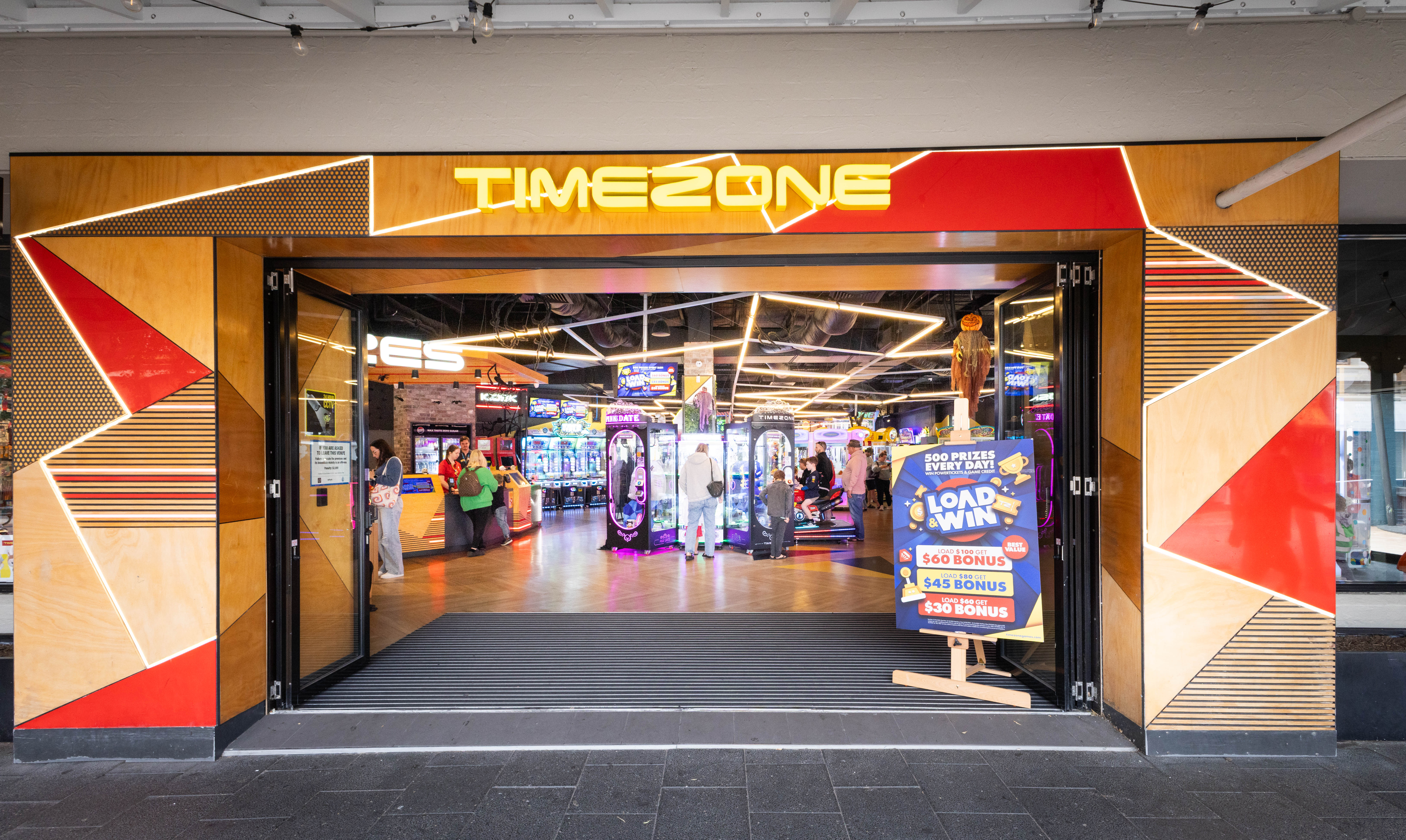
Timezone’s arcade in Fremantle. Photo: Michael O’Brien
ArcadeXR has a team of technicians in place to manage issues that arise with the machines or software, making that a more efficient process than repairing units in a variety of geographic locations.
Like many a warehouse the world over, ArcadeXR lacks the ambience of plush carpets and mood lighting and has no need for trained service staff: all costs that come with a physical venue.
A family entertainment centre can cost anywhere from $3 million to $10 million to fit out, yet its drawing power is limited by geography and the demographics within that area.
Even energy costs at the warehouse are not significantly higher, with the greater usage balanced out by reduced need for special lighting and air-conditioning.
Despite the comparisons, the Steinbergs are insistent they don’t see ArcadeXR as competing directly with the physical venues such as Timezone. Rather, they are moving into a different market with their experience in the amusement sector providing some synergies.
The ArcadeXR team noted that some games do better in the online environment than on the ground.
As a result, they are actively developing new games to test in the new situation, although they still believe it could be a proving ground for new products that then expand to physical venues.
“I think it meets different needs,” Adam Steinberg said.
“This is a playing experience, whereas Timezone is more a social experience.”
That difference has provided one of the challenges of mobile or online gaming: how to replace the collective experience of being at a venue?
Meta-games – created with the intention of providing long-term goals for players to keep them engaged longer – is not new but is a particular emphasis for the approach taken by ArcadeXR.
Another challenge is reaching a new audience.
A physical venue may be expensive but, once built it is its own billboard, as the bright lights and noise of the parlour attract those passing by.
Understandably, ArcadeXR has used social media marketing and other online mechanisms to find customers.
Adam Steinberg said the fact that a player in the US state of Wisconsin was actually playing a physical game in Osborne Park helped generate interest.
“That is novel in itself,” he said.
It provided an alternative offering in a crowded market.
“A lot of [companies] are trying to attract attention,” Adam said.
“This is a unique point of difference.”
This entrepreneurial approach of the Steinbergs has earned Malcolm one of the biggest fortunes in the state, putting his wealth at the billion-dollar level after estimates of value of TEEG emerged earlier this year.
He is one of 19 billionaires in the Rich 100 to be launched at the end of the month and released to subscribers early next.