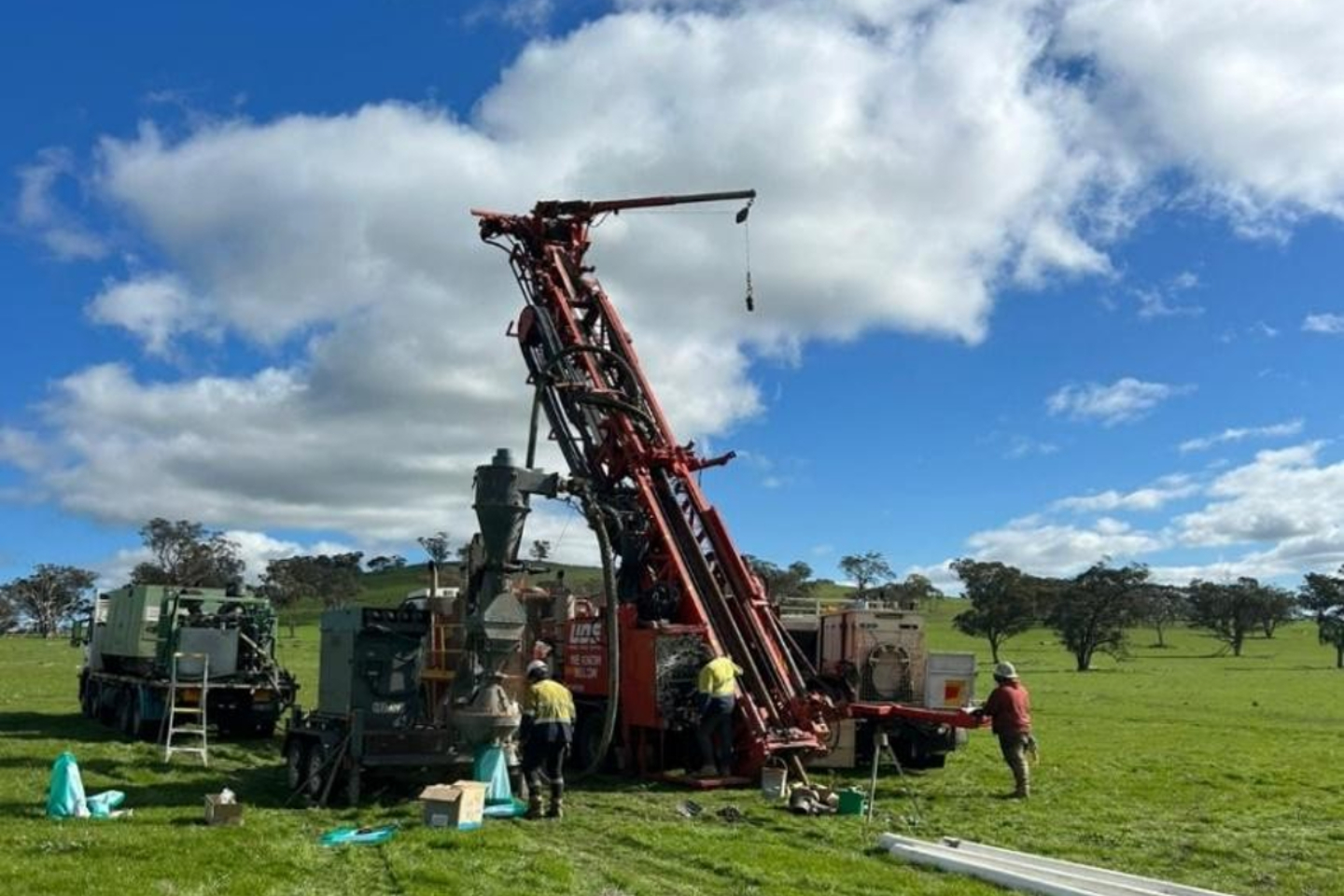
Xpedra Resources has fired up the drill rig again at its Springfield gold deposit in New South Wales, launching a 1000-metre follow-up campaign to chase mineralisation at depth after its maiden program delivered a string of wide, shallow gold hits right from surface.
The company’s initial foray at the project returned a swag of impressive results, including a 44m intersection grading 2.03 grams per tonne (g/t) gold from just one metre downhole. That hit contained a higher-grade 12m core going 3.46g/t gold from 25m.
Another significant intercept from the maiden campaign include 24m at 2.97 g/t gold from surface, with an 8m zone running a solid 6.71 g/t gold.
Assays from 19 of its initial 27 drill holes are now in the bag, boosting confidence in the scale and continuity of the shallow mineralisation. The rods are now turning on a new program designed to see just how far the system extends beneath these near-surface finds.
Xpedra Resources managing director Scott Funston said: “With Assays still pending from the final eight holes of the maiden program, we expect a continued flow of results over the coming weeks as we progressively build our understanding of the Springfield Gold deposit.”
The Springfield project sits near the historic gold rush town of Gulgong in New South Wales, within the richly endowed Lachlan Orogen. The geological belt is renowned for hosting some of Australia’s most prolific gold systems, such as Newmont’s monster 40-million-ounce Cadia-Ridgeway mine.
Remarkably, before Xpedra acquired a 100 per cent interest in the project late last year, Springfield had not seen a drill bit since 1999. The company’s due diligence unearthed some compelling historical drill results that were never adequately followed up, including an impressive 27m at 3.65 g/t gold from surface and a deeper 86m hit grading 1.04 g/t gold from 104m.
Xpedra’s work so far has tested to about 70m in depth, with management of the belief the mineralised intrusion has a potential strike length of more than 1.7 kilometres and remains completely open in both directions and at depth.
While the new drilling gets underway, the market will also be watching for the final eight holes from the maiden program, with assays expected in the coming weeks. These holes were drilled further along strike to the north and include four deeper, widely-spaced holes, which could provide an early clue as to what the current program might uncover.
With a string of broad, shallow gold intercepts already under its belt from ground that has been gathering dust for more than two decades, Xpedra has good reason to be excited about what lies at depth.
Is your ASX-listed company doing something interesting? Contact: matt.birney@businessnews.com.au


 By Andrew Todd