





FIRST comes love, then comes marriage; what comes next may be a debt-filled carriage.
And it’s that future financial burden, the rising cost of weddings amid a cost-of-living crisis, and an inflationary economic environment that have contributed to the closure of two prominent Perth bridal gown stores.
Last year, North Perth-based NOA Bridal owner Elizabeth Lyndon-James filed for bankruptcy, reportedly owing about $1 million to creditors.
Then, in May this year, Evercentre, trading as Pallas Couture, went into voluntary administration and has entered a deed of company arrangement.
It is the second time the company, which has studios in Sydney and Subiaco, has entered administration.
Budget concerns for contemporary couples have led to longer engagements, shorter guest lists, and more wishing-well requests in lieu of traditional wedding gifts, according to the Australian Wedding Industry Report for 2025.
In the report, Easy Weddings chief executive Matt Butterworth said the industry continued to feel the pinch of cost-of-living pressures.
In his foreword, Mr Butterworth said those couples who intended to marry in 2025 were predicted to spend 4.5 per cent more on their wedding compared with the previous year.
Despite these troubles, Juliet Studio owner Brittany Mason went against the grain to open a boutique bridal store in Subiaco in May, saying she saw a gap in the market for a different style of bridal gowns.
“I’m certainly not saying that Perth doesn’t have any bridal stores or any beautiful bridal stores,” Ms Mason said.
‘There are so many beautiful bridal stores in Perth ... actually, Subiaco has become a huge bridal hub, which is incredible.
“But if I were to meet someone and go get married in the next couple of years or something, I wouldn’t find anything for me being a bit more fashion forward, modern and contemporary.
“I’m bringing some different and some unique pieces, unique labels to Perth.
“I have maybe about ten brands that really want to stock in here.”
One of the largest bridal showrooms in Perth, Dion for Brides, opened a new Subiaco studio in mid-2024.
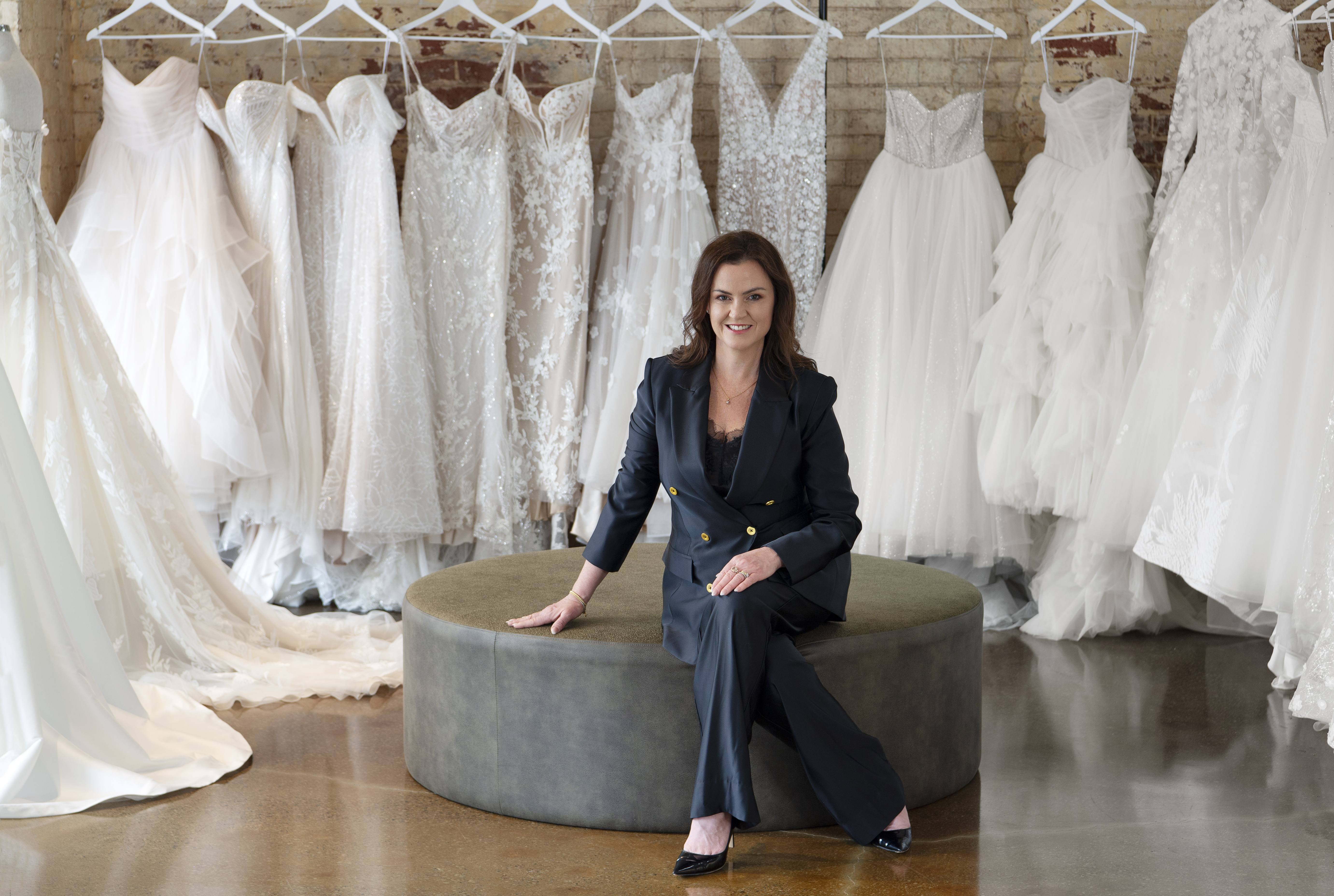
Lisa Selman says bridal budgets are at both ends of the spending range. Photo: Jody D’Arcy
Despite the business’s growth, Dion owner Lisa Selman said headlines over other bridal businesses in trouble had flow-on effects.
“We definitely see a reflection when those stories are in the news. We do get a lot of nervous brides ringing [asking] ‘are you okay?’ and we have to reassure them,” she said.
“Dion has been around since the early ’90s. I’ve only been in the business for eight years, but we haven’t let a bride down yet and we don’t intend to.
“I see a strong future. I think we have really cemented our place in the Perth market as being a leader in the bridal industry.
“[W]hen all the other stores were probably downsizing and going through a slowdown period post-Covid to re-establish themselves, we were moving and building a bigger showroom and a more luxurious space.”
Budget
In 2013, the federal government-run MoneySmart estimated the average wedding cost at $36,000.
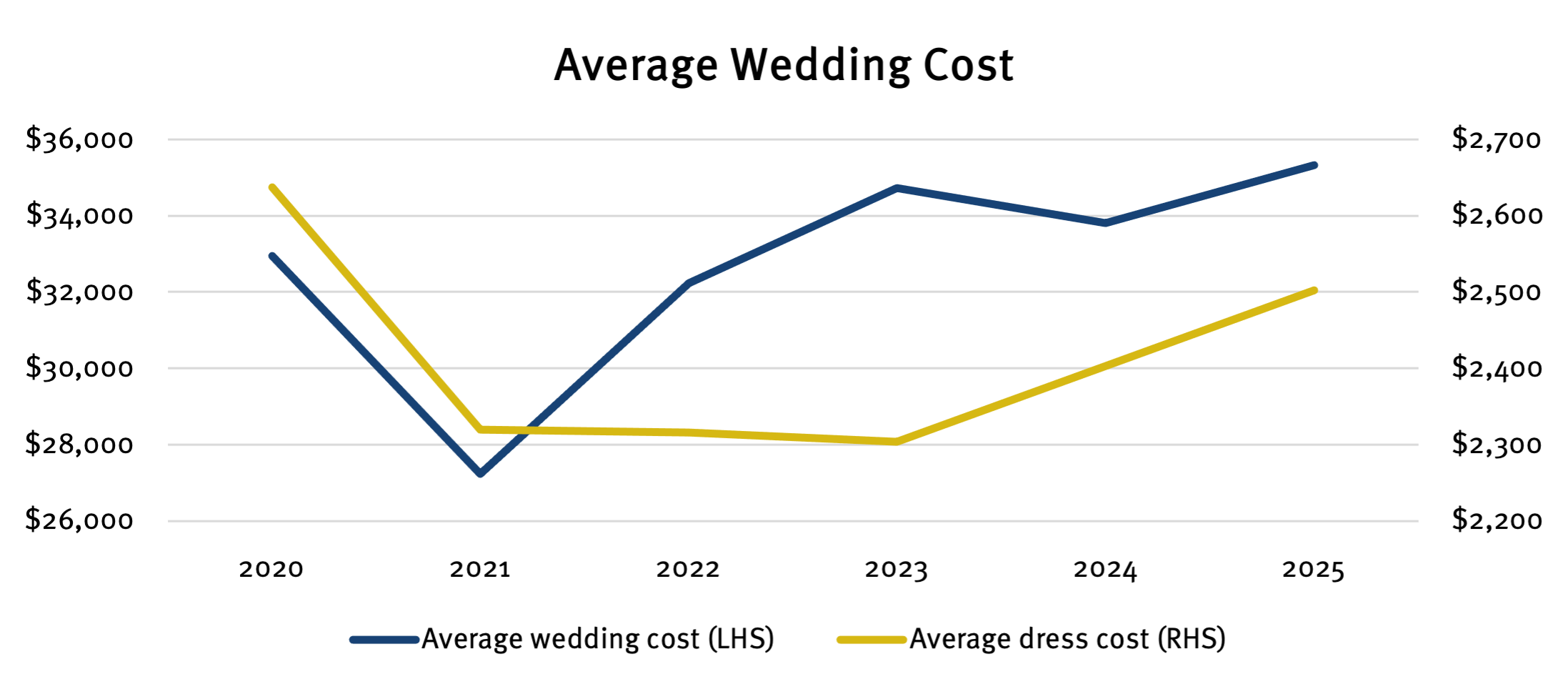
The Australian Wedding Industry Report for 2025, which surveyed more than 4,000 couples and 800 businesses across the country in 2024, found the average spend to be $35,315.
The average cost of a wedding dress in Australia is $2,502, up 4 per cent in the 2025 report compared to the previous reporting period. In Western Australia, that average cost is $2,586. About 95 per cent of brides surveyed for the 2018 wedding industry report opted to buy their wedding dresses. From 2022 to 2025, that figure was stagnant at 75 per cent.
Having previously run a make-up business for 10 years, Ms Mason said she had unknowingly been doing market research with her clients.
“I found a lot of my brides had been going over to Melbourne and Sydney and Brisbane to get their dresses. Or if they happen to be overseas, they will go to fittings over there or buy online. But it’s just risky,” she said.
Cizzy Bridal founder Kalvin Chow said the wedding industry had been hit by inflation, with middle-income consumers in particular leaving the market.
With Perth’s median house price approaching $1 million, Mr Chow said the economic impacts on the property market trickled down to the wedding industry.
“For people to spend some money on getting engaged, planning your wedding, getting married, they’re going to start to reconsider,” he said.
“‘Do I want to spend $50,000 to $60,000 on a ceremony, on a dress, and then, another $10,000 to $20,000 on a honeymoon?’
“‘Instead of spending the $80,000 to $100,000, should we just use that as a house deposit?’
“Unfortunately, the wedding industry is non-essential. It is purely based on emotions, and many people are now postponing their engagement [until] the next year.
“[They] keep saving, but then the more they save the more it inflates. It’s one of those vicious cycles at the moment.”
Source: EasyWeddings’ industry reports
Mr Chow said brides had also been cutting costs, including on tailoring.
“Customisation is a thing of the past,” he said.
“It will become a rental society for the middle class.
“Also, as houses get smaller and smaller – there are more apartments now in Australia than ever – how are you going to store that gown?
“Unfortunately, I see more stores closing down because of who’s buying them. Those [middle-income] clients are fading away.”
Ms Selman said there had been changes in how brides were spending the wedding budget.
“I’d probably say the changes, taking into [account] a post-Covid world and also factoring in the high cost-of-living concerns, is that today’s bride is probably more thoughtful and intentional,” she said.
“[S]he’s really trying to look for value in not just the gown itself, but the entire experience.
“We’re one of the only bridal houses that offer a full-service option, meaning we do in-house alterations.
“Being a full-service bridal boutique [means], we can really give her a service that is renowned and just can’t be met by any other store.”
Future
The latest Australian Bureau of Statistics data shows a rate of 5.5 marriages per 1,000 people in Australia, with 118,439 marriages registered in 2023.
It’s down from the peak of 127,161 marriages reported in 2022 but closer to the 113,815 recorded pre-Covid in 2019.
Mr Chow said a reset was needed in the wedding industry, and he expected more gown rental services would be offered in the coming years.
“I’d say that the lower-cost brands, the Toyotas of wedding gowns, would survive quite well,” he said.
“The Mercedes of dresses, and the BMWs of dresses and up and up, those will struggle. There will still be a market for it, don’t get me wrong, but it’d be less volume.”
Ms Selman similarly said she had seen brides spending at both ends of the budget for their dresses but ruled out a rental model for Dion.
“It probably is a perfect example of the challenges that the bridal industry faces,” she said.
“[W]e’re definitely having more brides ring with budgets that would traditionally be less than what we’re used to working with.
“[W]e do our very best to accommodate those inquiries and have definitely extended our collection to meet those needs.
“[But] we have also seen the opposite, where we’ve had our best-ever sales for gowns over $20,000 in 2025.
“At this point in time, and then certainly in the future, we don’t intend to get into the rental space because we believe those little moments, those alterations and those bespoke things that we can offer in store, they’ll outlast the trend. They’ll outlast the cost-of-living crisis.”
Dispelling some concerns over the industry, Ms Mason was confident the bridal gown market had a future.
“Weddings are kind of recession-proof,” Ms Mason told Business News.
“I think no matter what state the world is in, what the economic crisis is at that point; people always get married.
“Whether it be a blessing or a curse for the industry, I think brides will see something on Instagram, and they will want that, and they will not stop until they get it.”

