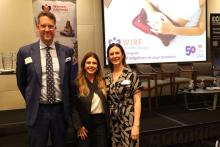
When Deborah Attard Portughes stepped into the role of Chief Executive Officer of the Women and Infants Research Foundation, she entered a sector defined by complexity, medical science accelerating at pace, healthcare systems under growing pressure, and women’s health research historically underfunded and undervalued. Nine years later, she has positioned WIRF not simply as a research institute, but as a strategic engine delivering measurable national health and economic impact.
This year marks WIRF’s 50th anniversary and what began as a small hospital-based research unit in Perth has evolved into the only medical research institute in Australia dedicated exclusively to women and babies, increasingly recognised as a globally connected hub influencing research priorities across the Asia-Pacific.
Deborah’s leadership philosophy has been shaped by more than two decades in the not-for-profit sector and a career that began in conservation. Yet her drive is also deeply personal. After experiencing pregnancy loss, Deborah made a decision to commit her career to changing outcomes for families facing similar uncertainty. “If we can spare even one family that pain, the work is worth it,” she says. That personal conviction now sits alongside a disciplined focus on systems, sustainability and return on investment.
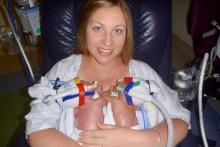
At the centre of WIRF’s strategy is one of the most consequential challenges in modern healthcare, preterm birth. Globally, 13.4 million babies are born prematurely each year and one million do not survive. Those who do face elevated risks of chronic disease, disability and lifelong healthcare dependency. In Australia, neonatal intensive care for a single preterm infant costs between $49,000 and $200,000, while downstream expenditure on long-term care exceeds $1.4 billion annually. The implications for both human outcomes and national health budgets are profound.
WIRF’s Australia Preterm Birth Prevention Initiative has reduced preterm birth rates in the state by 8 per cent and early births by 11 per cent in just two and a half years. The results have attracted $13.7 million in Federal Government funding to scale the initiative nationally. For policymakers and health economists, the equation is clear, targeted research translation delivering measurable cost savings alongside generational health gains.
“This is not research for research’s sake,” Deborah says. “It’s research designed for real-world implementation.”
That philosophy has reshaped how WIRF operates. Laboratory discovery is now paired with clinical integration, policy engagement and practitioner education, a model more commonly associated with high-performing technology enterprises than traditional medical research institutions. Current programs include artificial womb modelling to improve survival outcomes for extremely premature infants, precision steroid dosing to reduce maternal side effects, and a blood-based ovarian cancer detection test with the potential to redefine early diagnosis.
International collaboration has become a cornerstone of this strategy. WIRF now works closely with research teams in Japan and Singapore, including experiments placing ovarian cancer cells in micro-gravity simulation environments where cell growth has been shown to halt. These partnerships position Western Australia not as a peripheral research player, but as an exporter of innovation and intellectual capital.
Domestically, WIRF has also re-engineered how research collaboration occurs. Through WIRF’s Research Acceleration Awards, universities and institutes across Western Australia are aligned into coordinated research networks, reducing duplication and accelerating discovery pathways. “When institutions work in isolation, progress slows,” she says. “When we align capability, we create force.”
Sustaining this momentum requires more than scientific excellence. It demands capital, advocacy and community trust. Deborah has expanded philanthropic and corporate engagement pipelines locally and internationally, recognising that government grant cycles alone cannot sustain the pace of contemporary medical innovation. The result is a diversified funding model that positions WIRF not only as a research institute, but as an investable impact platform delivering quantifiable social and economic returns.
Yet at its core, WIRF remains a people-driven organisation. As a female CEO, Deborah has embedded leadership development and retention pathways for women in research, understanding that diversity in leadership shapes the questions science asks and the solutions it delivers.
“Future breakthroughs depend on who is in the room making decisions,” she says. “If we want better health outcomes for women and babies, women must be part of the leading solution.”
Looking ahead, Deborah’s vision for the next decade is clear, to establish WIRF as an internationally recognised centre for translational women’s and infants’ health research, to eliminate preventable preterm birth where evidence-based interventions exist, and to embed Western Australia as a globally connected research hub influencing healthcare systems across the Indo-Pacific and beyond.
Her definition of legacy is organisational rather than individual. “If WIRF is stronger, more connected and delivering greater impact long after I leave, that’s success,” she says.
In an era where healthcare systems face rising costs and increasing chronic disease burdens, Deborah Attard Portughes’ leadership offers a different narrative ,one where strategic research execution delivers both human and economic dividends, beginning at the very start of life.