Ensuring taxpayers receive bang for their buck should be a priority for all governments of all political persuasions at all levels.
As a journalist covering the fast-moving business sector, it is sometimes nice to sit back and look at the big picture: taking a deep dive into how much money is being spent and where, especially over the longer term.
One area of particular interest to me is the rising cost of the National Disability Insurance Scheme.
As its tentacles have grown, the NDIS has become both a giant part of the economy and an immense drain on the federal budget.
In financial year ending June 30 2014, the NDIS was just being put into action.
The budget estimated the Commonwealth would spend almost $700 million dollars in 2014-15 (the following financial year), ramping up to $11 billion by 2017-18, as it took over obligations of the states or otherwise spent money in this area.
I have no doubt something like the NDIS was needed, although Western Australia already had its own version, which was well managed, cost effective and did not cause much angst (from what I can recall).
Now I see the NDIS everywhere. It is a major employer, there are many businesses operating in this field, and the recipients are far more numerous than any treasury official could have imagined.
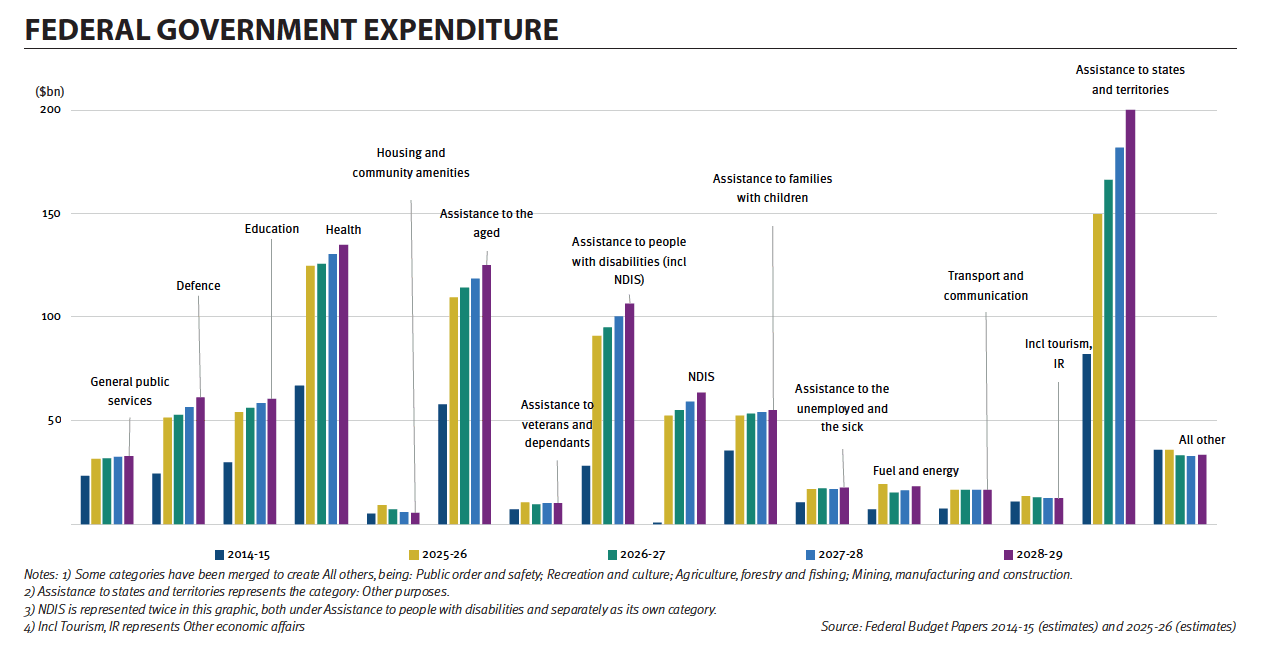
The NDIS is not the whole cost to the federal government of people with disabilities. But at just more than 50 per cent it is still staggering on its own at almost $53 billion estimated in 2025-26, rising to $63.6 billion four years out in 2028-29.
The scheme costs more than the defence budget and almost as much as that for education; both massive investments in our future.
A decade ago, disability spending was on par with defence and education. Now it dwarfs those two and, powered by the NDIS, is rapidly catching aged care and health.
More than 21 per cent of Australians have a disability. Disturbingly, that number is up almost a fifth from 2018, according to the Australian Bureau of Statistics.
Does that mean more people are becoming disabled or more people are reporting as such?
I suspect it is the latter. Which brings us to the cost.
We all want to do the right thing and help those in need.
Before the NDIS, most notably during the campaign to win political support for this concept, we were assailed by hard-luck stories of people with disabilities or, notably, volunteer carers (many who found their role unrelenting).
As I stated above, it was hard not to feel that something should be done, but even back then there was concern about what happened when this genie was out of the bottle.
I am sure the NDIS has relieved many people of a burden so great they wondered about the life they had previously.
I also know many people with a disability have been given opportunities that would never otherwise have come their way.
There are many cases where these positive changes have resulted in economic benefits and plenty more where the cost to society would be neutral either way. And the economic argument isn’t always the right one.
Whether or not a voluntary carer is more productive in their work because they were assisted by paid helpers isn’t always the point.
They deserve a life, too. But there is a dark side to this, and it isn’t recent.
The NDIS is a huge pot of money that has been abused by some.
At worst, businesses have been established with the sole purpose of cheating the system.
But there are others for which the funding is so generous there seems little control insofar as efficient management is concerned.
Dare I say it, the system is designed by government and, therefore, resembles a bureaucracy.
That the government is budgeting to spend almost $600 million over the next four years on NDIS quality and safeguards highlights how great that problem has become.
Clearly, spending in this sector has grown beyond anyone’s expectations.
It is one thing to be generous as a community. It is another to be reckless.