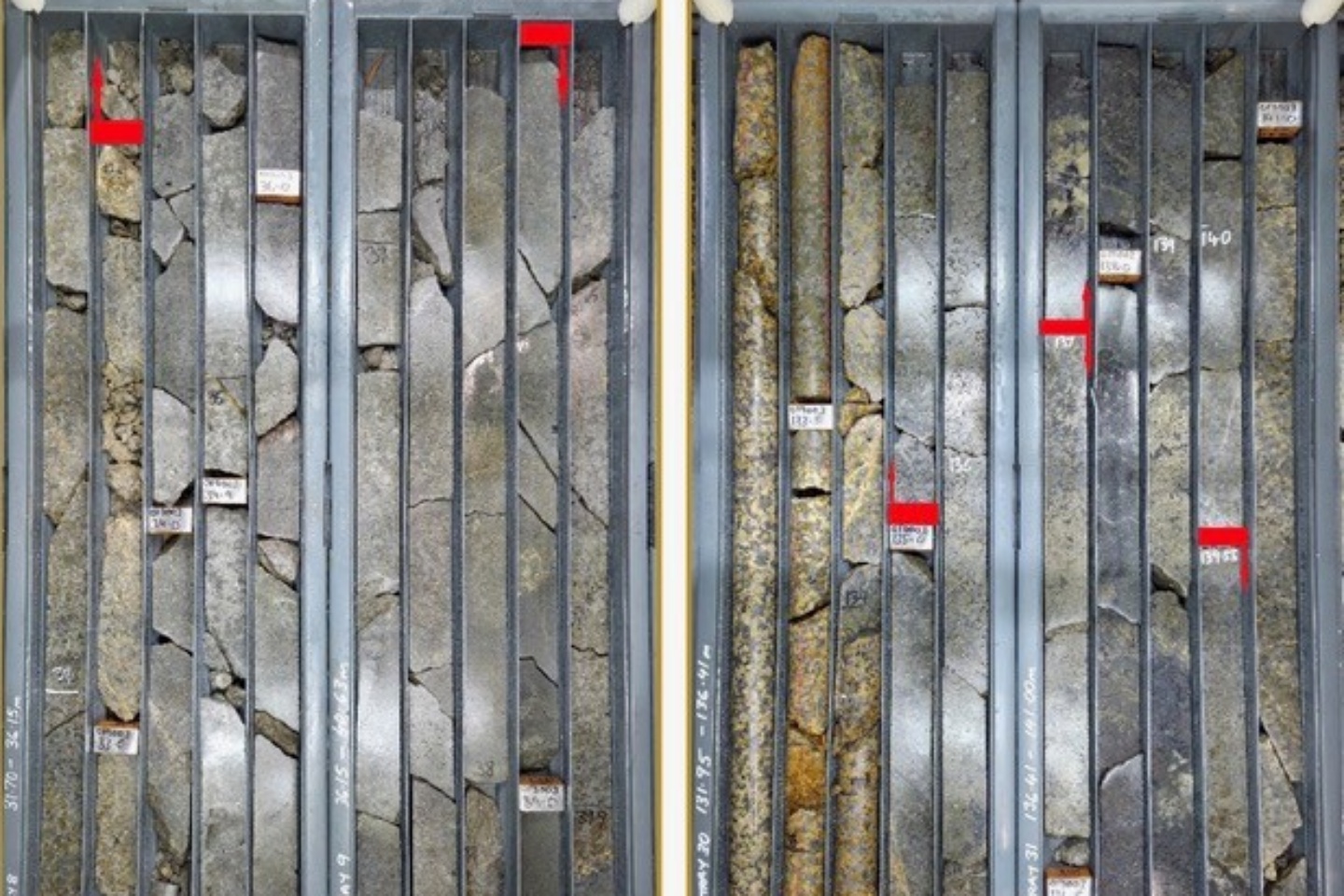
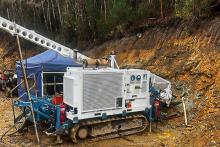
Octava Minerals has kicked off its 2026 field season with a flourish after firing up the diamond rigs again at its Sweeney’s copper-zinc-silver prospect in western Tasmania and snagging metres of visible sulphide mineralisation in the very first hole of the year.
Three diamond drill holes for a total of 457 metres of the planned 2000m program have now been completed at the prospect, which forms part of the Company’s Federation polymetallic project.
Encouragingly, visible semi-massive sulphides were logged in the initial drill hole, where mineralisation appears to occur within two separate lodes hosted in quartz-gangue zones.
This hole was designed to test the upper limit of a modelled electromagnetic plate generated from an earlier fixed-loop EM survey, targeting a shallow zone interpreted from historic drilling.
The drill rods recovered lenses of massive sulphide dominated by pyrrhotite, pyrite and sphalerite, with minor antimony-bearing boulangerite locally present. The presence of pyrrhotite nicely explains the magnetism.
The semi-massive sulphide lodes are surrounded by a halo of strong sericite and siderite alteration with minor disseminated pyrrhotite, pyrite and sphalerite developed within the host granite.
Core from the hole has been cut and dispatched to the laboratory, with assay results expected in mid-February to validate the visual observations.
While drilling continues at Sweeney’s, Octava has also reported standout results from reconnaissance rock-chip sampling at the nearby Anomaly 1 prospect, located about 750m northeast of Sweeney’s. The surface sampling, which targeted sulphide veins exposed during earlier earthworks, has delivered in spades, with high-grade base and precious metal numbers.
The strongest rock-chip assay result came in at 12.75 per cent zinc, 0.81 per cent copper, 199 grams per tonne (g/t) silver, 0.61 per cent tin and more than 500 parts per million (ppm) indium. Additional samples also returned elevated zinc, copper, silver and tin values, reinforcing the polymetallic tenor of the system.
Anomaly 1 sits within a broader, coherent multi-element soil anomaly, particularly well defined by historic tin-in-soil results.
In the 1970’s, Renison Goldfields Consolidated also sampled a historical adit at Sweeney’s, recording a very wide hit of 47m grading 0.96 per cent zinc, 0.64 per cent tin and 7g/t silver.
Octava says Sweeny’s was previously viewed as a greisen-style tin system, hosted by a rich intrusion called the Heemskirk Granite, which has punched through a sequence of Proterozoic-aged sedimentary rocks.
However, reinterpretation of the old drilling data suggests the structure could host a potentially larger remobilised massive sulphide body, with the addition of an intrusion-related copper-zinc-tin-silver sulphide feeder zone lurking below.
Octava says the mineralisation at Anomaly 1 is geologically complex and mostly concealed at surface, prompting the company to carry out earthworks to allow for proper drill testing. Drilling is pencilled in for later in the field season, once the current program wraps up on site.
Federation sits just 12 kilometres west of the Zeehan mining hub, in Tasmania’s mineral-rich northwest - home to the world-class Renison tin mine, Australia’s largest tin producer.
Renison has pumped out more than 200,000 tonnes of tin since the 1890’s and still boasts a 20-million-tonne resource grading 1.18 per cent tin. Back in the early 1970’s, Renison’s geologists focused purely on cassiterite at the mine; however, 18 drill holes cut into a copper-rich system that’s only now being appreciated.
Octava’s project enjoys a strategic position close to existing mining centres, infrastructure and hydro-power stations - a logistical advantage that could fast-track any future development.
With visible sulphides now confirmed at Sweeney’s and high-grade polymetallic results emerging at Anomaly 1, Octava is heading into a steady stream of drilling and results as it chases the broader potential of its Federation project in western Tasmania.
The combination of critical metals, robust geology and unexplored depth potential suggests Sweeney’s could yet become a cornerstone asset in Octava’s portfolio.
Is your ASX-listed company doing something interesting? Contact: matt.birney@businessnews.com.au





 28 Sep 2026
 14 Jul 2026
 29 Apr 2026
 29 Jan 2026
 04 Dec 2025
 25 Nov 2025