MetalsGrove Mining has landed a new, attention-grabbing gold result from its West African Zuénoula permit after soil geochemical sampling delivered a peak result of 583 parts per billion (ppb) gold from the company’s Fifty-Five prospect.
The standout hit has catapulted the company’s Fifty-Five target to the top of the exploration pecking order at Zuénoula.
Better still, the peak result sits near the centre of a 3.3-kilometre-long, northeast-trending corridor that encloses another seven close-spaced soil geochemical hits going better than 20ppb gold, which appears to remain open to the north-east.
The company’s momentum at Zuénoula has been steadily building this month. Earlier in March, it outlined a district-scale soil sampling program that initially highlighted the Fifty-Five area as a second-priority emergent target.
The latest fire-assay results have now defined seven separate prospect areas across the Zuénoula project.
In addition to the company’s previously flagged Fifty-Five, Central and South-East prospects, the company has prioritised four new zones, dubbed Eastern, Rouge, Konezra and South-West, with each area showing one or more soil anomalies above 30ppb gold from wide-spaced sampling.
Whilst the big hit at the Fifty-Five prospect stole the show, the nearby Central Prospect - about one kilometre to the south - has also firmed up well, with a new, emphatic 148ppb gold response confirmed from the previous 400-metre-by-400 metre infill sampling, within a broader anomalous area.
MetalsGrove managing director and chief executive officer Lijun Yang said: “These results represent a significant step forward in advancing the exploration on the Zuénoula permit, with the identification of a high-grade 583ppb gold soil anomaly at the Fifty-Five Prospect within a 3.3 km anomalous trend, together with multiple newly defined prospects. This highlights the strong district-scale potential of the project.”
Building on this work, MetalsGrove plans to tighten up the grid at Fifty-Five to a 200-metre by 200-metre infill spacing across 12 square kilometres.
That higher-density sampling will be combined with a more open 400-metre by 400-metre scout grid of step-out samples covering an estimated 11 square kilometres, designed to chase the anomaly further to the north-east.
The proposed extension to the scout grid at Fifty-Five will follow what appears to be the regional trend of Birimian greenstones, the existence of which is strongly reflected in the regional aeromagnetic data.
A more extensive 400-metre by 400-metre infill soil geochemical program over a 34- square-kilometre area also looks to be on the cards between the Central and Eastern areas to help pin down what could be a bigger structural corridor.
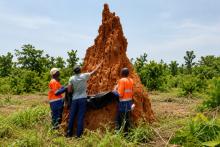
More recently, MetalsGrove kicked off integrated regolith mapping and a high-resolution drone-based LiDAR survey over priority zones to sharpen structural interpretation and increase confidence in gold distribution under cover.
The regolith mapping is nearing completion, and in light of its new high-grade geochemical results, the company has extended its drone-borne LiDAR-orthophoto survey northwards from the Central area to cover the Fifty-Five prospect.
With a growing swag of prospects, the company is lining up tighter sampling programs across its new areas and with fresh digital terrain and regolith data landing on the desk, MetalsGrove looks well-placed to keep the Zuénoula story on the boil.
The bulk of the results are concentrated along the southern and eastern borders of the permit area. However, one of the new prospects has offered a tantalising glimpse of something meaningful in the southwest corner of the property, with five soil sample responses ranging from 20 to 59ppb gold, spaced 1 to 3.5km apart.
Intriguingly, that cluster of results sits directly on the main line of structural strike that continues to the northeast through the Fifty Five and Central anomalous zones.
This is one prospect crying out for another round of sampling, where a close-spaced line of samples across its eastern boundary could confirm the inferred northeasterly strike control on mineralisation.
Well-designed and run soil geochemistry can be super-sensitive and a good guide to potentially mineralised areas, especially in ground that has not been heavily disturbed.
As always, though, the ultimate proof of the pudding will come with the necessary infill sampling to home in on targets and the first follow-up with the drill rig.
Big hits like the 583ppb gold at Fifty Five and 148ppb at Central are a great start to the program. The other five sample clusters, up to 59ppb gold in the southwestern corner, are also telling.
So far, the geochemistry appears to be responding well and delivering good values in coherent clusters.
The market will be on tenterhooks for the next round of infill results to see what they show, while the eventual follow-on drilling will be the ultimate validation test of the exploration methods employed.
Once those hurdles are crossed and drilling supports soil geochemistry that points to compelling subsurface targets, MetalsGrove will be off to the races and can use the lessons learned by spreading its wings further afield in similar terrain.
Is your ASX-listed company doing something interesting? Contact: matt.birney@businessnews.com.au


 By Doug Bright