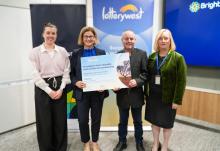
One week before Christmas last year, Lotterywest announced the winning tender for one of the state’s largest technology projects.
US-based Brightstar Global Solutions Corporation was selected to implement a new gaming system that will link Lotterywest to 480 retailers across the state and its national partner.
It will also provide software to support Lotterywest’s back-office operations plus website and mobile applications.
Chief executive Colin Smith said the project was critical for Lotterywest.
“There is no room for failure, the technology is foundational for us,” Mr Smith told Business News.
There are 80 people in Perth working on the project, split between Lotterywest staff, local contractors and Brightstar’s team.
“It’s a major undertaking, a once-in-20-year project,” Mr Smith said.
The total contract value is $332 million over 19 years.
This includes $33 million for the implementation phase, $226 million for operating costs over the 19-year contract term, and $9 million for hardware.
The contract value also includes “options for future development” of about $60 million.
Under the terms of the agreement, Brightstar will convert the gaming system run by the incumbent contractor, Greek company Intralot.
“The current system is old and very constrained,” Mr Smith said.
Brightstar has become the global market leader in this space, operating eight of the top 10 lotteries around the world.
“There is only a handful of providers and no local provider,” Mr Smith said.
Brightstar, like Intralot, will establish a Perth office to help run the system.
“They are setting up a local office here so they will have a team to run the operations post implementation,” Mr Smith said.
He believes the new system will boost both the in-store experience and the digital channel.
“Lotterywest is largely a technology business because our games are run on the platform,” Mr Smith said.
“The experience in the store should be better for players.
“When you have technology that is 17 years old, you are really constrained.
“We will be able to innovate and also think about different products.
“At the moment there is a long lead cycle for new product development.
“Having modern technology will help us respond.”
National links
Lotterywest’s Scratch n Win and Cash 3 games are unique to Western Australia but most of its games, such as Powerball and Oz Lotto, are national operations.
These games are managed through the Australian Lottery Bloc, which represents gaming bodies across the country.
Since it was established in 1982, the bloc has changed dramatically as a result of the privatisation of state-based lotteries.
In practice, it’s a collaboration between just two entities – Lotterywest and ASX-listed The Lottery Corporation – the latter of which has bought the rights to run lotteries in every other state.
Its operations highlight just how differently things are done in WA, which is unique in retaining a state-owned lotteries operator that gives back most of its revenue to the community in prizes and grants.

Lotterywest’s sales revenue has plateaued in recent years. Photo: Michael O’Brien
The Lottery Corp evolved out of Tattersalls, an organisation that originally ran sweepstakes on horse races and acquired the Victorian public lottery licence in 1954.
As Tatts Group, it acquired Golden Casket in Queensland, followed by NSW Lotteries in 2010 and SA Lotteries in 2012.
In May this year it paid an unprecedented $1.15 billion upfront fee to the Victorian government to extend its licence in that state for a further 40 years.
It holds similar long-term licences in other states, making for a lucrative national business.
For the year to June 2026, The Lottery Corp reported revenue of $3.57 billion and net profit after tax of $284 million.
The entire profit was paid out to shareholders as dividends, while its community contribution was just $5.2 million.
Major differences
Lotterywest’s financials look very different.
Its revenue last financial year was about $1.3 billion and it has, quite deliberately, a negligible operating profit.
Where did the money go?
After covering its operating costs, Lotterywest paid more than $760 million in prizes and distributed a further $404 million via community grants.
Mr Smith is proud of how much Lotterywest returns to the community, via prizes and giving.
“There aren’t many businesses out there where 93 per cent of the money gets back into the WA community in some capacity,” he said.

There are a couple of other notable differences between Lotterywest’s business model and that of its big interstate counterpart.
The Lottery Corp runs keno games across the eastern states.
These games can be played every three minutes and deliver a higher profit margin, judging by The Lottery Corp’s latest financials.
Lotterywest has refused to offer keno in WA and has supported a national campaign against online keno.
This campaign recently resulted in the federal government announcing it would ban both online keno and foreign-matched lotteries.
Mr Smith said these products did not adhere to the same player safety standards that Lotterywest had maintained.
“This is a great outcome for our retailers, who depend on a well-regulated lotteries sector to run their businesses in the communities they serve,” he said, adding that Lotterywest had strict advertising guidelines.
“We take responsible gambling very seriously.
“We don’t target vulnerable groups, we don’t advertise near schools or universities, do not advertise between sporting events.
“We definitely don’t offer inducements.”
It also has a $500-a-week limit for customers who play online.
“Lotteries are at the lower end of gambling harm but, regardless, we still take it very seriously,” Mr Smith said.
“It’s critically important to our social licence to operate.”
He also emphasised that Lotterywest sought to differentiate itself from online sports betting.
“None of our advertising is about trying to attract those people.
“People play our games for a bit of fun, some hope, and they also know it goes back to the community.”
Online trends
Another notable difference between Lotterywest and The Lottery Corp is the amount of online gambling.
Digital sales account for 46.6 per cent of The Lottery Corp’s total sales. In WA, digital sales are much lower, at 29 per cent, which may be less efficient but is good news for retailers.
“The retail channel is absolutely essential for our success,” Mr Smith said.
Lotterywest paid $93 million in commission to its 480 retailers last year, which in many cases is a significant proportion of their revenue.
It is also spending $39 million over five years to help its retailers through a ‘better business’ program.
This covers everything from training to wellbeing services.
It also facilitates advice on leasing and provides modelling to help retailers understand the best location for a new store.
A notable trend among retailers has been a shift to kiosks, which makes for a lower-cost entry.
There has also been considerable churn among the retail partners.
Last financial year, there were 44 changes of ownership and five new retail outlets, while nine retailers closed their business. Mr Smith believes this reflects normal turnover among small businesses.
Retailers will need to transition to the new gaming system, which will go live in the third quarter of 2027.
The ‘cut-over’ will be on a Sunday night, when turnover is at its lowest.
Mr Smith said Lotterywest would also be minimising any other change coming into that event.
“I’m confident about the cut-over,” he said.
“We have assembled a very good, globally experienced team that has done this many times before.
“It’s all about the integrity of the system, you cannot afford to lose a ticket.”
Performance
While Lotterywest promotes responsible gambling, its key performance measures include growth in total sales.
On that front, it has struggled during the past two years, after a record-breaking 2023-24 when sales peaked at $1.38 billion.
Annual sales have dipped to about $1.3 billion since then.
Mr Smith believes a big factor was that 2023-24 featured multiple large jackpots, which attracted more spending.
By contrast, the past two years have not had many big jackpots.
Sales per adult have been trending even worse.
They dipped to $526 last financial year, the lowest in four years and, when the FY26 numbers are finalised, they are expected to be even lower. Mr Smith puts a positive slant on this.
“We’ve seen more players playing but they are spending less and we think that is a great outcome,” he said.
Another key performance indicator is the percentage of sales allocated to beneficiaries.
“Our target is to get 30 per cent of sales out in distributions or grants, but it can fluctuate,” Mr Smith said.
The lack of a profit motive means Lotterywest focuses on its costs to gauge performance.
Its ‘lottery operating expenses’ as a percentage of sales jumped to 6.5 per cent in FY25, up from 5.5 per cent the prior year.
Mr Smith said this figure was likely to go up again because of spending on the new gaming system, before dropping in later years.
Many of Lotterywest’s 310 full-time equivalent staff are focused on distributing grants rather than running lotteries.
Its ‘grants operating expenses’ were steady at 11.9 per cent of discretionary grants in FY25.
Community return
Mr Smith said there was no shortage of demand for Lotterywest grants.
“The past 12 months we’ve seen unprecedented demand,” he said.
“We have teams working in the field across the state to get insights on unmet community needs.
“That guides everything we do.”
The largest portion, about $185 million, was allocated to support health outcomes across the state. The arts and sport sectors received $23 million each in funding.
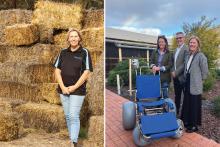
A record $172 million of discretionary grants were made to 452 not-for-profit organisations and local governments last year.
The largest individual beneficiaries were Screenwest ($10.8 million) and Perth Festival ($9.6 million).
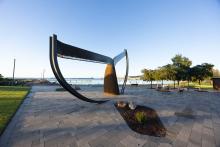
Highlights last year included a $2.9 million grant supporting Good Sammy’s new Canning Vale headquarters, helping to create employment opportunities for people living with disability, and $4 million towards the Kurlu Kurlu Wirri play space in Port Hedland.
Mr Smith said Lotterywest had a formal acquittal and evaluation process, especially for larger grants, but did not seek to measure its return on investment.
“A lot of it is about cohesion and capability building,” he said.
As well as running Lotterywest, Mr Smith is chief executive of Healthway, which delivered $22 million of grants and sponsorships last year for sport, arts and community activities, and health promotion projects.
The two bodies also share a chairperson in Karen Brown.
As part of their integration, Healthway pays about $3.5 million a year to Lotterywest to run its back-office shared services.
Mr Smith believes the two organisations are complementary and are able to refer grant applicants to each other to find the most appropriate program.
Lotterywest also seeks to partner with other donors.
“We do partner alongside philanthropic foundations, where we can come together and have greater impact,” he said.
Since Lotterywest was founded more than 90 years ago, it has paid out $11 billion in prizes and $6.3 billion has been given back to the community.
“They are mind-boggling numbers, that’s inspirational as a state.” Mr Smith said.