



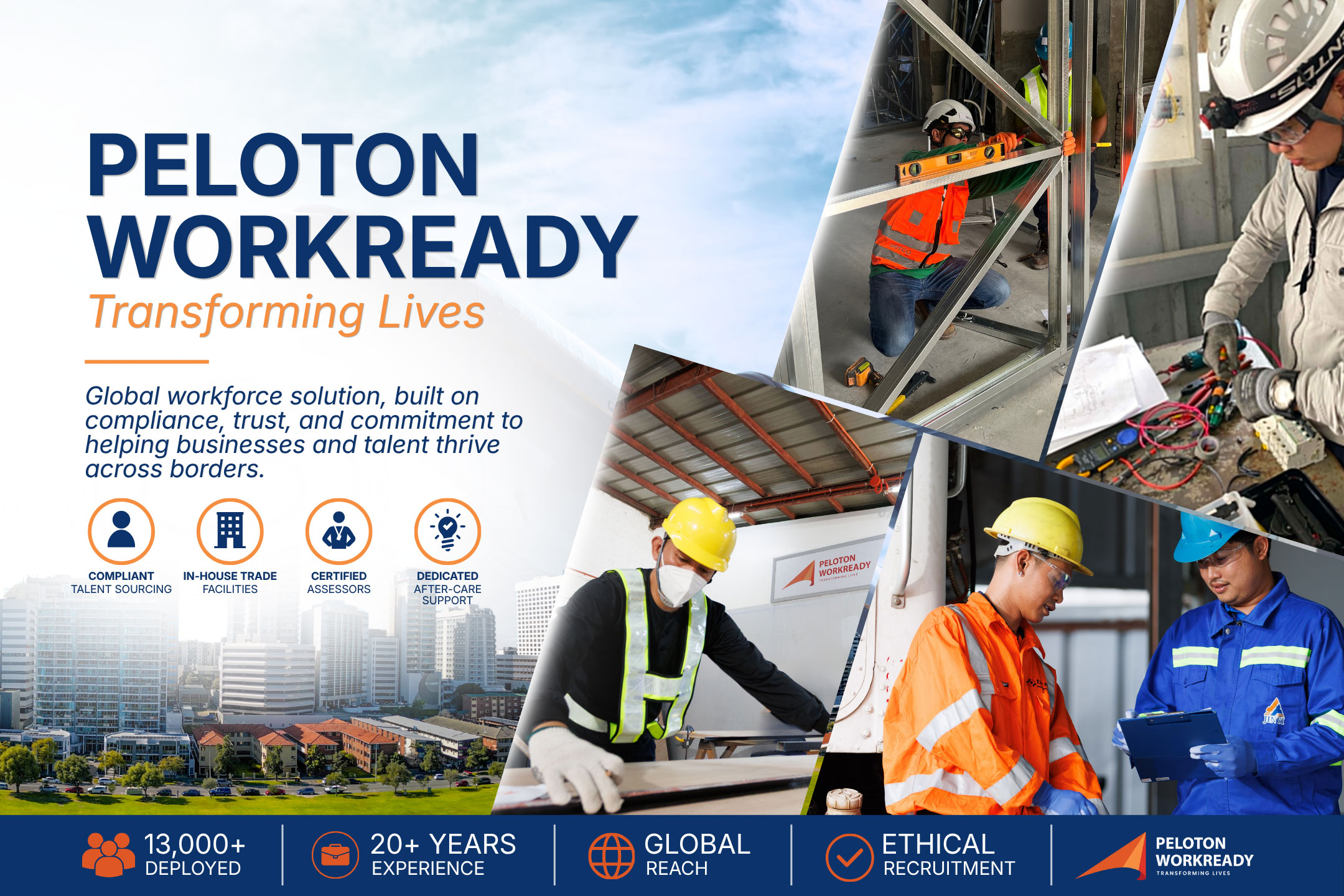
WA businesses do not just need more workers. They need people who are screened, assessed, prepared, compliant and supported before they arrive on site.
Workforce solutions provider Peloton WorkReady says the state’s labour challenge is shifting away from simple headcount shortages and towards capability, readiness and retention.
Peloton WorkReady chief executive Brett McPhee said the focus must move beyond recruitment volumes and towards workforce performance from the start.
“Businesses are telling us they do not just need more applicants, but they need people who can do the job safely and effectively from day one,” Mr McPhee said. “The gap is emerging not in hiring activity, but in job readiness.”
The company positions itself not just as a recruiter, but as a workforce partner helping employers reduce risk and improve performance through pre-assessed and pre-prepared candidates.
The shift comes as WA continues to invest heavily in workforce development, with the 2026–27 State Budget allocating $216 million toward training, apprenticeships and workforce initiatives, including fee-free and low-fee TAFE pathways and clean energy training infrastructure.
While government investment aims to expand the pipeline of skilled labour, industry players such as Peloton WorkReady argue that employers still face challenges in translating training into immediate on-site capability.
Mr McPhee said readiness must be embedded before workers are deployed, not corrected after hiring.
“By the time someone is on site, it is too late to discover gaps in technical skill, safety awareness or communication,” he said.
“Employers need assurance earlier in the process, before selection, not after onboarding.”
Assessed before arrival
A core part of Peloton WorkReady’s model is pre-selection assessment through its in-house Trade Assessment Facility, where candidates are evaluated on technical ability, safety awareness and workplace readiness before employers make hiring decisions.
The approach aims to shift recruitment away from resume-based screening and towards evidence-based capability testing.
Candidates are assessed by certified trainers and assessors in structured environments designed to replicate workplace expectations – an approach which Mr McPhee says helps employers make more confident hiring decisions.
“When a candidate has already been tested in a controlled environment, employers are not relying on assumptions or paperwork. They are making decisions based on demonstrated ability,” he said.
Reducing hidden business risk
Beyond capability, Mr McPhee argues that poor-fit hires carry significant downstream costs, including rework, supervision pressure, safety risks and productivity loss.
“Every incorrect hire has a cost – not just financially, but in workload, safety exposure and team performance. Verification before deployment reduces that risk substantially,” Mr McPhee said.
Screening, trade testing and verification of competency processes are designed to reduce those risks before workers are placed.
Candidates undergo screening and competency testing in accredited facilities in the Philippines and Dubai prior to selection, with employers receiving verified confirmation of skills aligned to Australian workplace expectations.
Readiness beyond technical skill
Peloton WorkReady’s stance on job readiness extends beyond trade capability to include safety understanding, communication skills and cultural awareness.
Mr McPhee said this broader definition is increasingly important across safety-critical industries. “A job-ready worker is not just someone who can perform a task,” he said.
“It is someone who understands how to work safety, communicate effectively and operate within Australian workplace expectations from once they enter the workforce.”
The company provides pre-deployment training and an Australian Culture and Communication Program, designed to prepare workers for workplace norms, safety standards and day-to-day integration.
Tailored workforce solutions
Rather than offering a one-size-fits-all recruitment model, Peloton WorkReady tailors workforce solutions based on project requirements, timelines and skill needs. This can range from small cohorts of specialist trades to larger-scale workforce deployments.
Mr McPhee said flexibility is essential given the diversity of WA industries and project environments. “No two businesses operate the same way,” he said.
“A workforce solution has to reflect the realities of the site, the timeline and the capability required.”
The company’s “3Cs” framework – client compatibility, compliance and collaboration – underpins its recruitment approach.
Compliance and ethical recruitment
Workforce readiness also includes compliance with Australian visa and employment requirements, an area Peloton WorkReady says is central to reducing administrative burden for employers.
Mr McPhee said compliance support is critical for businesses navigating international recruitment pathways.
“Employers should not be carrying unnecessary risk when it comes to documentation and compliance,” he said.
“Our role is to make that process structured, transparent and aligned with regulatory requirements.”
The company also emphasises ethical recruitment, including a no-fee model for candidates, with all placement costs covered by employers.
“Ethical recruitment is not optional anymore – it is a baseline expectation,” McPhee said.
“When workers are not paying to access opportunity, it creates a more sustainable and transparent system for everyone involved.”
Support before and after arrival
Peloton WorkReady also provides pre-deployment support such as assistance with bank accounts, insurance and tax file numbers, alongside onboarding preparation.
Workers also complete cultural and communication training before arriving in Australia, aimed at reducing adjustment challenges and improving early-stage performance.
Mr McPhee said early support translates directly into workplace outcomes. “The smoother the transition into Australia, the faster workers become productive contributors,” he said.
“It is about removing friction before it shows up on site.”
To further support employers, Peloton WorkReady offers a three-month replacement guarantee if a worker does not meet performance expectations.
Mr McPhee said this reinforces accountability across the recruitment process. “Employers need confidence that we stand behind our placements,” he said. “The guarantee is part of ensuring long-term success, not just filling a vacancy.”
Capability across industries
While workforce shortages are often discussed in mining and resources, Peloton WorkReady says its model applies across construction, engineering, manufacturing, industrial trades, HVAC, plumbing, automotive, healthcare, hospitality and administrative roles.
Mr McPhee said the underlying issue is consistent across sectors. “Whether it is a workshop, a hospital or a construction site, the expectation is the same – people need to be ready to perform safely and effectively,” he said. “That is where workforce success is won or lost.”
As WA continues to invest in training and workforce development, organisations such as Peloton WorkReady are positioning themselves as the bridge between education pipelines and real-world performance – closing the gap between hiring and capability.