Bulls N’ Bears Big Hits takes a look at notable drill intercepts reported to the ASX last week, led by New Murchison Gold and followed by Golden Horse Minerals and SQX Resources, with results spanning development‑focused drilling to early‑stage discovery.
New Murchison Gold (ASX: NMG)
Project: Crown Prince East Pit, Western Australia
Hit: 18 metres at 10.3g/t gold from 54m, including 6m at 29.3g/t gold.
New Murchison Gold has taken top Big Hits billing for last week after reporting a high‑grade development intercept from its Crown Prince East pit design in WA – a result that could move quickly from drill core to mine plan.
Crown Prince East is a satellite deposit 300m east of the active Crown Prince West pit at the Crown Prince gold mine, 17km north of Meekatharra.
The 18-metre hit, grading 10.3 grams per tonne (g/t) gold from 54m, included 6m at 29.3g/t and came from the company’s recent 49‑hole reverse circulation (RC) program for 5365m. The campaign was designed to test lodes within the existing Crown Prince East pit outline.
Another strong result from the same campaign, confirming down-dip continuity from the headline result, delivered 12m at 10.3g/t gold from 34m, including 1m at 42.2g/t from 36m in an adjacent hole on the same section.
That matters because mineralisation already sitting inside a pit design can be slotted straight into resource updates, pit optimisation and mining schedules – much faster than a typical greenfield discovery.
The drilling is also starting to show where the best gold sits. In simple terms, Crown Prince East has two main sets of gold‑bearing lodes, and the stronger grades occur where those trends come together.
Next, New Murchison plans to fold the results into a JORC compliant resource update and re‑optimise the pit design ahead of mining, helped by the fact that Crown Prince East is already covered by the existing Crown Prince mining approval.
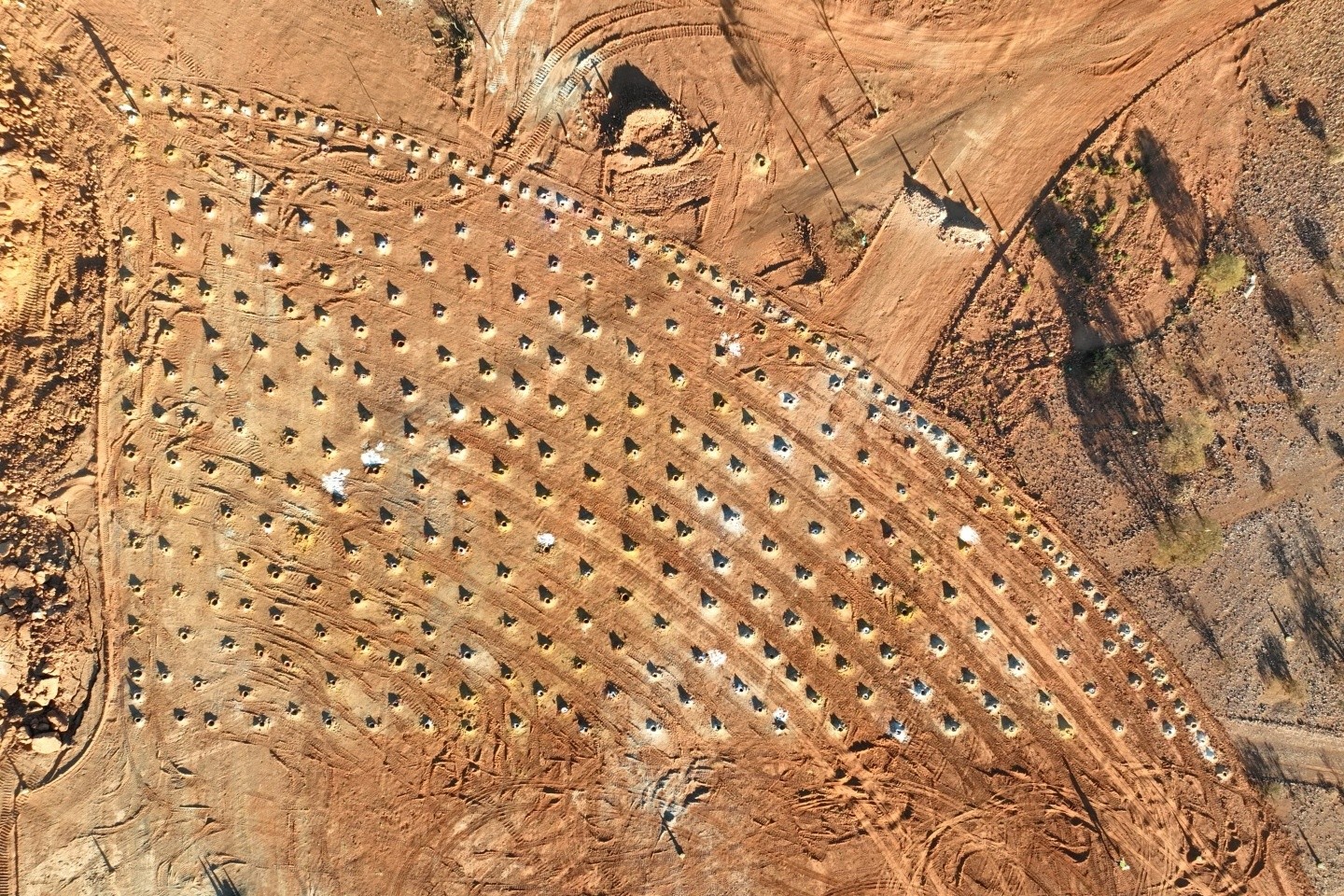
A pre-blast shot-hole pattern at New Murchison Gold’s Garden Gully gold project near Meekatharra in WA. Credit: File
Golden Horse Minerals (ASX: GHM)
Project: Hopes Hill South, Western Australia
Hit: 7 metres at 13.0g/t gold from 13m, including 2m at 44.3g/t gold.
Golden Horse Minerals has jagged second place in last week’s Big Hits parade after delivering a shallow, high‑grade intercept that looks more like a discovery than an incremental step‑out at Hopes Hill South, near Southern Cross in WA.
The company drilled the hole as a proof-of-concept to test its geological interpretation that the Hopes Hill shear zone could be a large-scale mineralised gold system.
The drill targeted a shear‑hosted position 200m from historic workings to determine whether the shallow old workings marked a few isolated mineralised pods or were, in fact, the surface hint of a larger, coherent and repeatable gold system.
The standout result of 7m at 13.0g/t gold from 13m, including a bonanza 2m at 44.3g/t, was backed by the company’s original drill sampling. Initial 4m composite samples included one exceptional hit grading 41.2g/t from 12m, which prompted a fresh 1-metre re-sampling program that ultimately delivered the reported 7m interval.
Golden Horse says the intercept sits in a new structural position in the hanging-wall ultramafic unit, raising the possibility of stacked lodes or splays in the Hopes Hill South area, rather than a single structure.
The practical implications are clear. The company’s step‑out drilling can now focus on strike and depth continuity of this newly defined zone, while broader RC and diamond work continues across the company’s Hopes Hill system.
SQX Resources (ASX: SQX)
Project: Red Bird Gold Project, Arizona, United States
Hit: 24.4 metres at 3.1 grams per tonne gold from 22.9m, including 9.1m at 6.6g/t gold.
SQX Resources ran third in the Big Hits polling for the last week. However, it still posted a strong early‑stage result, with broad, near‑surface gold intercepts from maiden drilling at its Red Bird project in Arizona, pointing to an emerging system with upside.
The company’s hero intercept of 24.4m at 3.1g/t gold from 22.9m, including 9.1m at 6.6g/t, is supported by other broad near-surface hits extending to 60m depth. The growing dataset points to continuity across multiple sections and a shallow geometry that appears well-suited to open-pit development potential.
Red Bird lies in Arizona’s southeast and is surrounded by a veritable swarm of other significant major copper, gold and molybdenum projects and deposits, including Pinto Valley, Morenci, Rosemont, Resolution, Florence, Silver Bell, and Copper Creek.
The overall host rock environment for these deposits is broadly characterised as multiple 50 to 75 million-year-old Laramide-age porphyry copper systems. The deposits are typically associated with porphyritic intrusions, such as granodiorite to quartz monzonite bodies. These intrusions have pushed into older Precambrian crystalline basement rocks and Palaeozoic sedimentary sequences, including limestone, quartzite and shale.
The 25‑hole, 2509m RC program was SQX’s first systematic modern test of the historic Red Bird mine and its surrounding alteration footprint. The campaign was designed to test whether the old workings lie within a bigger epithermal system, which might signify greater strike and depth potential.
Results from 14 of the holes have been reported. With assays from the remaining 11 drill holes still to come, attention now turns to the bigger prize - just how large this mineralised system could become, how far it stretches, and whether repeat parallel structures may host more high-grade cores.
SQX is planning an induced polarisation (IP) geophysical survey to map chargeability responses and track potential sulphide-bearing feeder zones, helping prioritise step-out drilling along strike and beneath the current shallow mineralised envelope.
The company is also planning to undertake further detailed underground geological mapping and sampling, especially of deeper levels, which have not yet been accessed.
Is your ASX-listed company doing something interesting? Contact: matt.birney@businessnews.com.au