The Energy Constraint Quietly Slowing Australia’s Industrial Expansion




Western Australia has always been defined by its ability to solve difficult industrial problems.
For decades, businesses here have operated in some of the harshest and most demanding environments in the world — across mining, manufacturing, transport, logistics, infrastructure, and energy. That operating environment has forced WA industry to become highly practical, highly innovative, and exceptionally resilient.
Today, however, a new challenge is emerging across Australian industry, and it has the potential to significantly slow economic growth if we do not address it properly.
The challenge is power availability.
Across the country, we are seeing more industrial businesses ready to expand operations, electrify equipment, deploy EV charging infrastructure, and modernise facilities, only to discover the electrical grid cannot support the additional demand.
For many sites, obtaining sufficient power is no longer a straightforward infrastructure request. Grid upgrades can take years, involve complex approvals, and require millions of dollars in investment before a business can even begin scaling operations.
That delay creates a serious economic bottleneck.
When manufacturers cannot increase production, when transport operators cannot electrify fleets, or when industrial facilities cannot access the energy capacity they require, the impact goes well beyond electricity supply. It affects productivity, investment confidence, operational efficiency, and ultimately Australia’s industrial competitiveness.
At Magellan Power, we recognised this issue several years ago.
We could see that the pace of industrial electrification was accelerating much faster than traditional grid infrastructure could respond. We also recognised that businesses needed a practical solution that could be deployed immediately, not years down the track.
That thinking led us to develop Magellan Power’s Hybrid Power Booster.
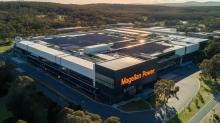
The Hybrid Power Booster is an Australian-designed and manufactured system that combines advanced battery storage, intelligent control systems, and power electronics to effectively increase the usable power available at industrial sites.
In practical terms, it allows businesses to operate beyond the limitations of their existing grid connection.
Rather than waiting years for major network upgrades, a business can deploy a containerised Hybrid Power Booster and rapidly increase operational capability, support large industrial loads, and enable high-power charging infrastructure.
The applications are broad and growing rapidly across sectors including manufacturing, mining, ports, logistics, transport depots, remote operations, and commercial EV charging infrastructure.
This becomes particularly important as Australia moves further toward electrification.
Heavy vehicles, industrial fleets, and commercial transport systems will require enormous amounts of reliable power delivered quickly and consistently. Yet much of the existing grid infrastructure was never designed to accommodate this level of concentrated demand.
That is where battery-integrated power boosting becomes transformative.
Instead of relying solely on grid capacity during periods of peak demand, the Hybrid Power Booster intelligently combines stored battery energy, solar generation, and available grid supply to support high-power operations while reducing stress on the network itself.
Importantly, this is not simply an energy storage discussion.
It is fundamentally about enabling industrial growth.
Too often, the conversation around energy focuses purely on electricity pricing. But for many industrial businesses, the far greater cost comes from constrained production, delayed expansion, operational downtime, or the inability to electrify operations at the pace required by the market.
Solving grid limitations is increasingly becoming a strategic business issue.
Australia needs to think more carefully about how we approach the broader energy transition.
We cannot afford to become a nation that simply imports advanced clean-energy technologies while exporting the economic opportunity that comes with them.
If we are serious about building long-term industrial capability, then Australia must strengthen its ability to engineer, manufacture, maintain, and continuously improve these technologies locally.
Western Australia is exceptionally well positioned to lead this.
We already possess deep expertise in power systems, advanced engineering, automation, mining technology, and remote-area operations. We understand how to design systems that perform reliably in extreme heat, dust, vibration, and mission-critical industrial environments because WA industry has been solving those challenges for decades.
At Magellan Power, this is why we continue investing heavily in local engineering, manufacturing, apprenticeships, and research and development.
We are not designing products for laboratory conditions. We are building systems specifically for Australian operating environments - systems that must perform reliably in demanding real-world applications where downtime is simply not acceptable.
The energy transition should not be viewed solely as an environmental objective.
It is also a major industrial opportunity.
If Australia gets this right, we have the potential to create sovereign capability, highly skilled jobs, advanced manufacturing growth, and globally exportable technologies that are designed and built here.
The Hybrid Power Booster is one example of what becomes possible when local engineering capability, manufacturing expertise, and practical industrial experience come together to solve real problems.
Western Australia has always helped power the nation through resources and energy.
The next chapter is about helping power the future through innovation, advanced manufacturing, and intelligent energy systems developed right here in WA.
Oil and gas services
| 13th | - | IPI Packers | 69 |
| 14th | - | LR Logistics | 67 |
| 15th | - | Magellan Power | 63 |
| 16th | - | Auto Control Systems | 50 |
| 17th | - | Pressure Dynamics | 80 |