





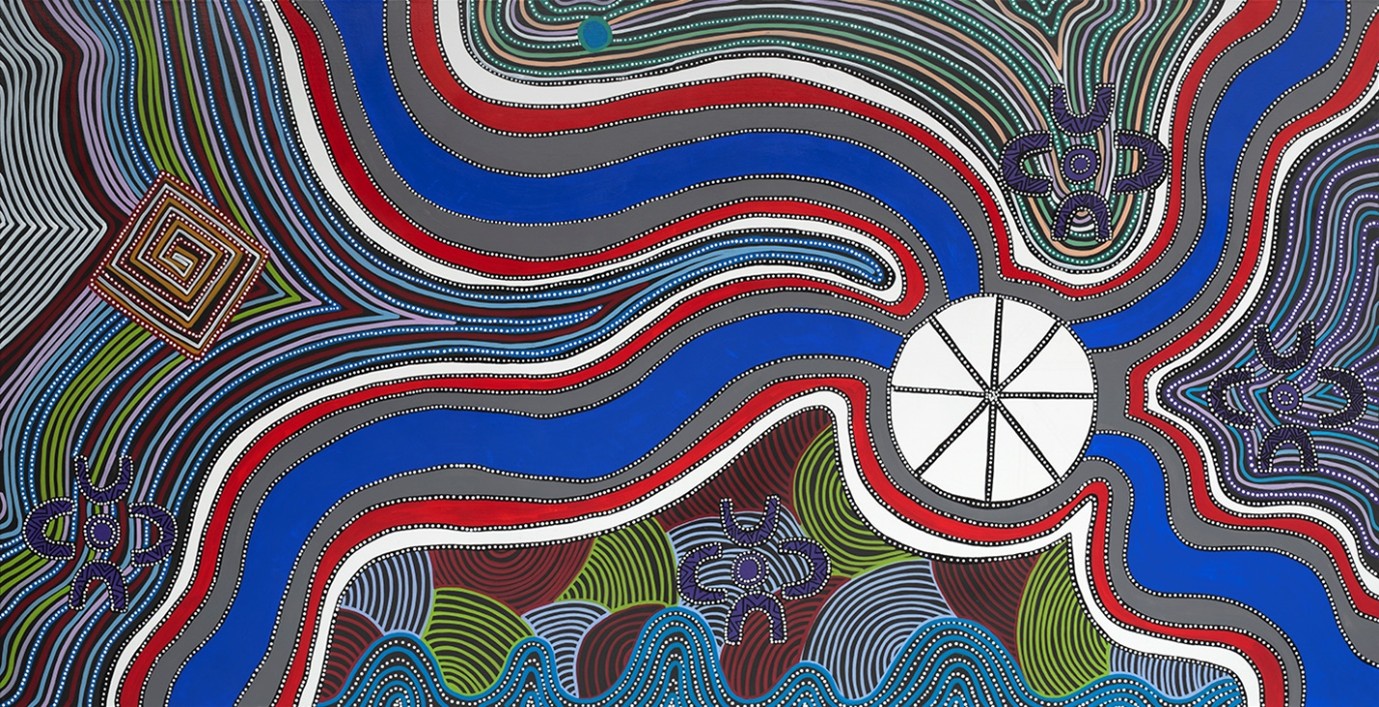
Yondee is an award-winning Noongar Whadjuk Ballardong artist, recognised for contemporary works that respectfully integrate traditional Aboriginal storytelling with modern design.
This artwork serves as an acknowledgement of Country. It supports the development of our Reconciliation Action Plan, reflecting our commitment to understanding our role, responsibilities, and impact within the built and environmental conditioning services sector.
Ancient Winds is a visual narrative that expresses the deep connection between land, water, wind, and people. The artwork depicts landforms, waterholes, and river systems through flowing, wavy lines that traverse the land's surface. These pathways symbolise vital water sources – lifelines that sustain both the environment and those who move across it.
Curved lines also represent mountain ranges and rocky outcrops, while dotted and linear pathways mark travel routes, hunting grounds, and ceremonial journeys. Concentric circles signify waterholes, lakes, and rain, emphasising the central role of water as a source of life, renewal, and continuity.
Swirling and curved motifs illustrate the movement of wind – an essential element in Aboriginal knowledge systems. Wind is closely observed to interpret weather patterns, seasonal change, and environmental signals. Certain winds may signal the approach of rain, storms, or the onset of critical seasonal activities. Within stories, songs, and ceremonies, wind often represents spiritual forces or ancestral presence, carrying meaning beyond the physical world.
For Aboriginal people, land, wind, and water are inseparable. Changes in water levels and flow patterns signal seasonal transitions and environmental health, guiding hunting, gathering, and movement across the country. This deep understanding of natural systems reflects generations of observation, survival, and cultural practice.
Ancient Winds embodies this enduring relationship – honouring custodianship, ancestral knowledge, and the passing down of lore through visual storytelling. It speaks to an intimate awareness of Country, where environmental forces are not only understood but respected, guiding both practical living and spiritual life across generations.


