When a fabricated component fails outside a planned maintenance window, the cheapest repair quote is often not the cheapest outcome. The right decision takes into account availability, fit, total cost, and the value of every day the machine sits idle.
For most mine maintenance teams, an unplanned failure triggers one question. ROX Mining Parts Area Manager Vern Fowler puts it down to the simplest of statements: "The moment a machine goes down outside of a planned maintenance window, the only question the team are really asking is 'how quickly can I get it back to work'?"
The answer is one of three: fix the damaged part, replace it or just wait for a part. All three options have associated costs which won't be reflected in the initial quote.
Why is a repair quote rarely the actual cost?
Repair is normally the first thing you'd consider for a damaged fabricated item (tank, fender, guard, etc.) when you have no spare on hand. The issue is that you don't always know the full extent of the accident damage or fatigue cracking until the component has been removed, stripped, and inspected. By that stage, the job is already underway, and both the cost and the time to get it done are going to increase significantly.
"A replacement is a known number, a repair is an estimate" said Mr Fowler.
A temporary repair can also lead to a second planned shutdown if a permanent repair is still required later.
What costs are outside the repair quote?
A fabricator's quote covers the repair itself. It does not cover:
- Freight. Components that can't be repaired on site have to be moved. Mr Fowler's estimate for urgent freight from a remote mine site is $2000 to $4000 each way.
- Auxiliary parts. Mounting hardware, seals and gaskets often need replacing when the component goes back on.
- Coordination time. Someone has to manage the repairer, the inspections, and the return-to-service date.
- Lost production. This is normally the biggest number.
A perfect example of this from ROX Mining Parts (a $20k repair quote on a haul truck part) is that the repair cost is the smallest line in the comparison. If the truck is out of service for 33 days rather than 2, at a production cost of $8k-$16k per day, the lost production is $264k-$528k. The actual figures will vary from machine to machine, site to site, fleet to fleet and commodity to commodity, but the principle is the same. The repair cost is the smallest line.
When does waiting actually make sense?
Waiting for an OEM part can be the right choice if the site has spare fleet capacity and the failed piece isn't on the critical path. A site with fleet redundancy can absorb a number of weeks of downtime with minimal impact on production.
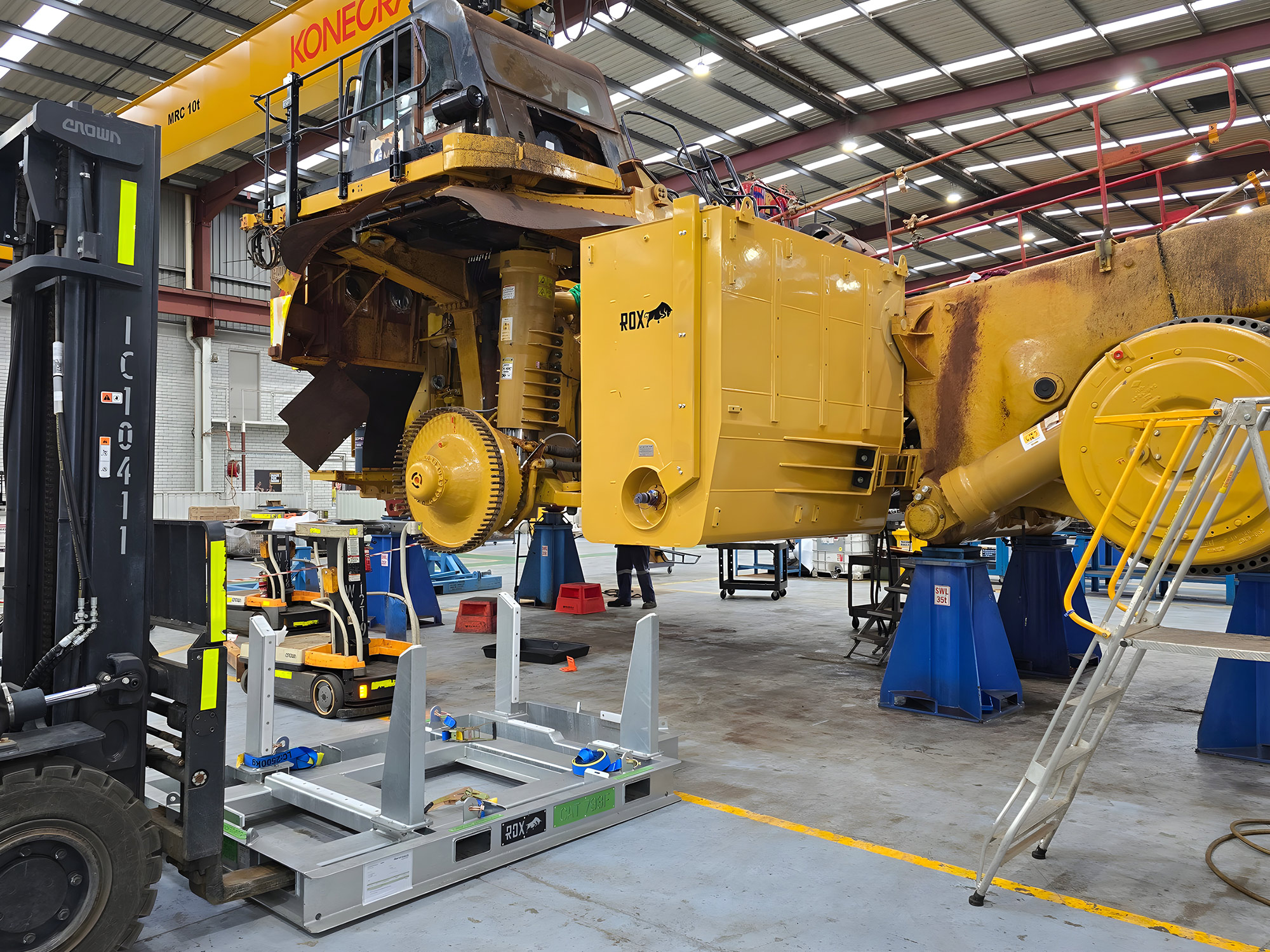
The calculation is different on a constrained fleet. Some OEM replacements for fabricated components aren't held in Australia and have very long international lead times. One example from ROX was an OEM fuel tank for a haul truck with a lead time of at least six months. When your waiting period is measured in months rather than days it's no longer a viable option at the time of an unplanned breakdown.
What four questions should a maintenance team be asking?
Before you commit to a repair, a replacement, or a wait, Mr Fowler recommends four checks.
- Is a replacement available? Confirm the part is actually in stock with a realistic dispatch date. An estimated manufacture date doesn’t mean the part is ready to ship.
- Will it fit the actual machine? Check the model, serial number range, and component specification, and ask for the drawings, engineering documentation, and parts list.
- What's the total cost of the repair? All of it. Removal and installation, freight, aux parts, labour, management time and any extra planned downtime.
- What's the value of the downtime on this machine? Put a dollar value on each day the asset is down and take into account how much spare capacity the fleet has.
How can sites make that call prior to a failure?
The best time to be comparing options is before anything breaks. Mr Fowler says you get better outcomes from a team when you look at replacement items as part of rebuild and shutdown planning, rather than after a component has already gone to a repairer.
"That's a planning conversation rather than a breakdown conversation and it's a far better one to be having," he said.
Mapping out which fabricated components have long lead times and which have a local replacement available gives the planner a fallback option before they actually need it.
About ROX Mining Parts
ROX Mining Parts is owned by Bend-tech Group, a Perth-based, ISO certified group of five businesses: CDEC (consulting, design, engineering and construction for mining and heavy industry), ROX (OEM replacement parts for mining equipment), Grizzly (workshop and maintenance equipment), BT Metals (tube and flat bed laser cutting and material processing) and Toolsafe (toolboxes and workshop equipment).
Bend-tech Group holds ISO 9001, ISO 14001 and ISO 45001 certification for quality, environmental and health and safety management.
ROX Mining Parts supplies fabricated replacement parts for mobile mining equipment (fuel and hydraulic tanks, fenders, guards, handrails, access systems, etc.). They have a range of finished components in stock in Perth, Newcastle, and Brisbane, and customers can review the GA drawings, engineering sign-off, and parts list against their machine serial number before ordering.
See the ROX fuel tank range or download the full Australian Mining Review report, Equipment Downtime: Why Quick Fixes Cost Miners More.
ROX components are not OEM parts. The manufacturer names are for reference only.