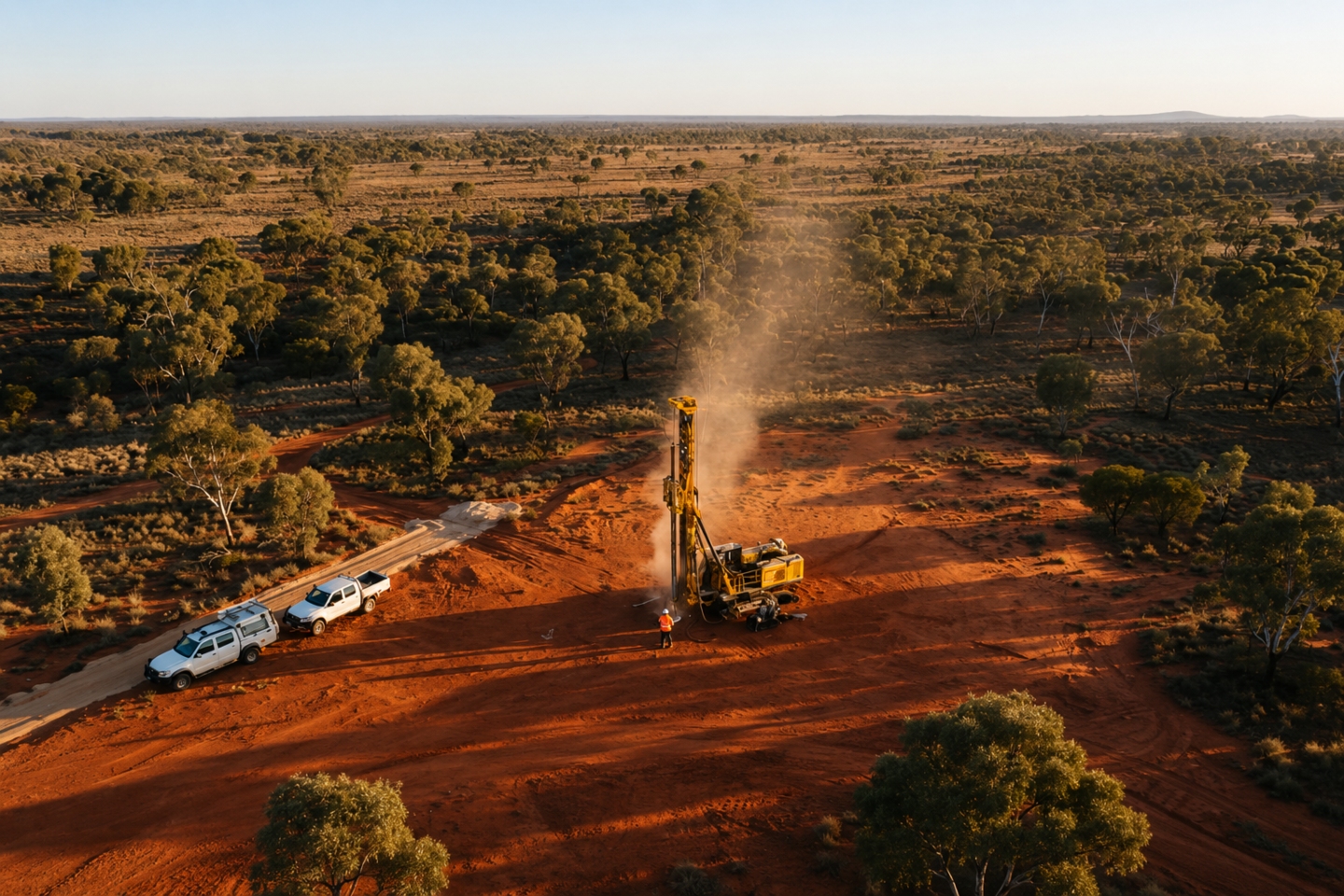
Neometals Limited has hit paydirt again at its Rinaldi copper prospect in Western Australia, with a new 6-metre intercept grading 1.56 per cent copper and 20.8 grams per tonne (g/t) silver. The result confirms primary copper sulphide mineralisation continues at depth beneath the historic workings.
The hit from the company's 100 per cent-owned Barrambie project in WA's Murchison region adds another notch to the emerging copper-silver story. It also sets the stage for the next big swing – its T2 geophysical target 700 metres away, which the drill bit is yet to properly test.
The headline intercept came from 101m depth and included a higher-grade core of 1m at 2.96 per cent copper and 40.2g/t silver. A second hole returned 5m at 0.43 per cent copper from just 31m as part of the July campaign designed to test above and beneath significant March hits.
Those earlier successes included 7m at 1.72 per cent copper and 25.9g/t silver, and 5m at 1.26 per cent copper alongside 20.8g/t silver. Management interprets the recurring copper-silver association as further evidence of a coherent primary hydrothermal system beneath the shallow, weathered workings.
The drilling is probing the deeper roots of a copper system, which has already provided plenty of history at surface. Between 1956 and 1961, the old-timers reportedly mined just 1407 tonnes of ore at a stunning average grade of 9.8 per cent copper for 138 tonnes of contained metal.
T2 now looms as the next piece of the puzzle. Its strong chargeability anomaly has a core just 110m below surface and extends more than 200m laterally and at least 300m vertically.
However, water ingress put a premature end to the first crack at it. The hole hit a significant water structure at 104m and battled on to 124m before being abandoned short of its planned 175m depth. Logging picked up broad pyrite and quartz veining towards the bottom of the hole and visually identified chalcopyrite from 108m, although assays are needed to determine copper grades.
Neometals Limited managing director Chris Reed said: “The assay results confirm that primary copper sulphide mineralisation continues at depth beneath the historic Rinaldi workings, with encouraging grades and widths reported from the completed holes.”
Neometals plans to return with a diamond rig in September to drill a tail on the curtailed T2 hole and test the full target, subject to operational conditions and relevant approvals. A detailed ground magnetic survey and soil geochemistry program is also being designed to better define the structures controlling Rinaldi mineralisation and verify potentially anomalous historic soil results in the area.
There is plenty more news in the pipeline. Today's results cover just 33 samples representing 9 per cent of the 338 generated by the four-hole, 388m Rinaldi campaign – fast-tracked after showing visual signs of potential mineralisation.
Copper, gold and silver assays from the remainder are still to come, meaning the early batch is not necessarily representative of the broader prospect. Further drilling will also be needed to pin down the lode's changing dip, continuity, scale and ultimately its economic significance.
The recent campaign also included 662m across five reverse circulation holes at the nearby Ironclad gold prospect, with gold assays still to come.
Rinaldi finds itself in some useful geological company. The prospect sits within the same geological sequence and along strike from Solstice Minerals' Nanadie copper-gold deposit, home to an inferred resource of 40.4 million tonnes grading 0.4 per cent copper and 0.1g/t gold. Neometals says the geological similarities point to the district's broader copper potential.
The bigger picture is Barrambie's 40km-long greenstone belt, where gold and copper exploration spent more than two decades largely in the shadows as attention focused on its giant titanium-vanadium inventory. With precious and base metals now attracting the drill bit, the wider belt is finally getting another look.
With another solid copper hit in the bag, Neometals has steadily built the case for a primary copper system at Rinaldi. However, the main event may still be about to come, with the September diamond drill test of the much bigger T2 target shaping up as the next major catalyst for the project.
Is your ASX-listed company doing something interesting? Contact: matt.birney@businessnews.com.au






 24 Sep 2026
 04 Sep 2026
 17 Jul 2026
 12 Jun 2026
 19 May 2026
 23 Apr 2026