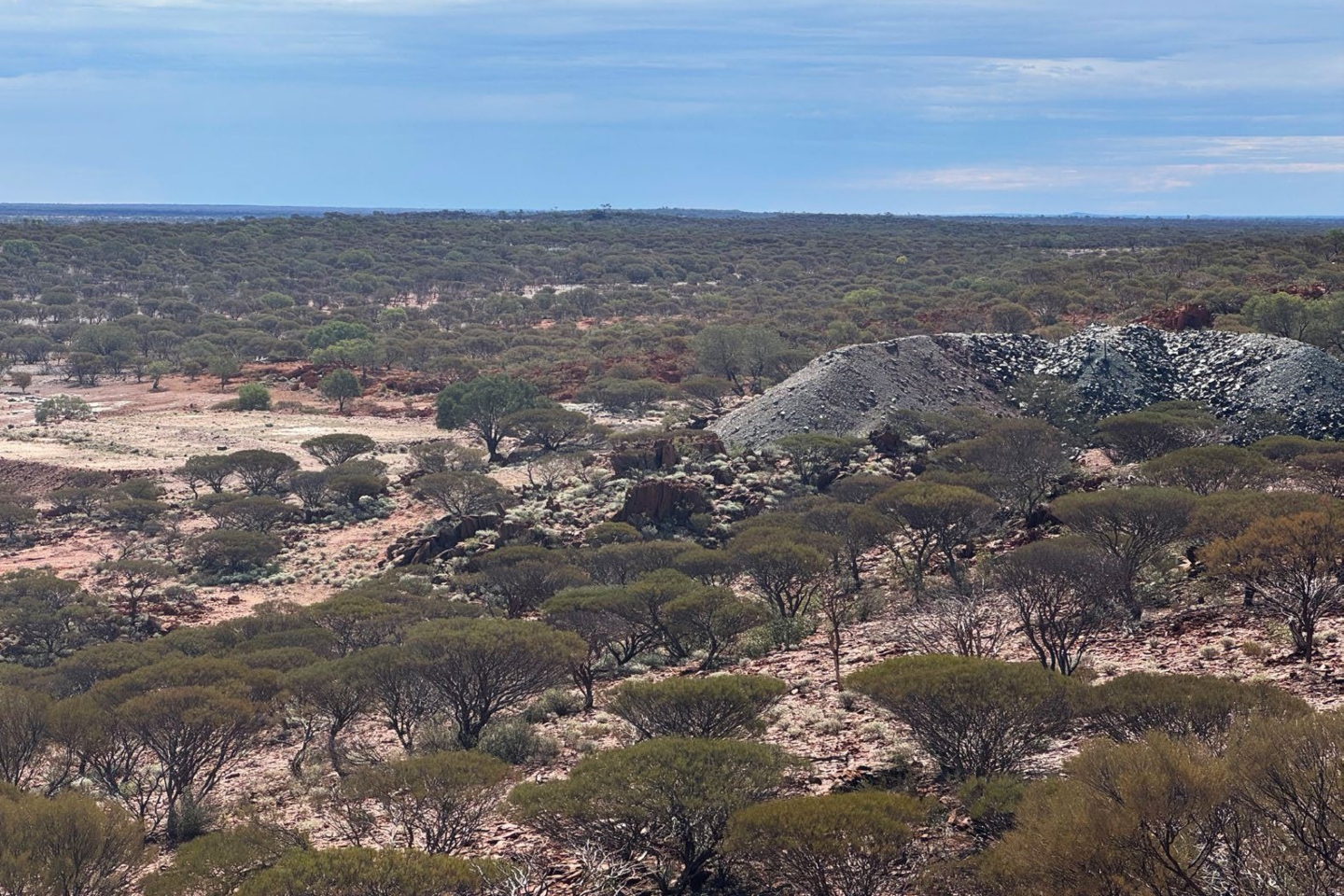
Neometals has struck high-grade gold from resource extension drilling at its 100 per cent-owned Ironclad deposit, part of its broader Barrambie gold project in Western Australia’s Murchison region. The company's 5-hole reverse circulation (RC) drilling campaign in July has returned a suite of impressive intercepts, headlined by a 12-metre run at 5.99 grams per tonne (g/t) gold from 116m, including 4m going 10.13g/t gold from 118m.
That result was strongly reinforced by a second hole which nailed 11m grading 5.50g/t gold from 94m, including a satisfying high-grade core of 3m at 15.10g/t gold. The third and thickest run from the five holes put into Ironclad delivered 18m at 2.14g/t gold from 89m, which included 8m at 3.29g/t gold from 89m and another 2-metre chunk assaying 4.61g/t gold from 103m depth.
Neometals says its latest results from Ironclad, which also include another notable 15-metre hit from 69m grading 1.12g/t gold, support its interpretation of a high-grade, north-west-plunging mineralised corridor which may be getting richer at depth.
The drilling campaign involved a total of nine RC drill holes for 1050m, with five holes in the Ironclad gold project for 662m and the remainder allocated to the Rinaldi copper prospect. The principal aim of the Ironclad program was to probe interpreted extensions of higher-grade mineralisation plunging north below the deposit's current mineral resource estimate.
Management says all four completed holes at Ironclad, which attained their target depths, returned significant gold mineralisation over widths exceeding 10m, with the three deepest drilled holes offering up the best grade-by-width intersections recorded from the deposit so far. The company's fifth and deepest planned hole was abandoned due to water ingress.
Adding a compelling new dimension to the geological puzzle, a recent on-ground gravity survey has identified a potential “feeder” structure associated with the Ironclad deposit, which Neometals says may be a fluid pathway for gold mineralisation in the immediate area.
The company believes that the feeder structure could be associated with the major Youanmi Shear zone, a deep crustal-scale structural feature only 3.5 kilometres east of Ironclad, which defines the eastern contact of the Barrambie Greenstone Belt with the ancient granitoids of the Southern Cross geological domain.
Notably, the Youanmi Shear is a major structural influence on gold mineralisation in the Sandstone area, 85km south of Ironclad, and also at Rox Resources' Youanmi gold mine, another 85km south of Sandstone.
Neometals Limited managing director Chris Reed said: "All four completed holes returned significant gold mineralisation over widths exceeding 10 metres and, importantly, the deepest drilling at Ironclad has delivered some of the best grade-width intersections we have seen to date. The results are strengthening our view that Ironclad hosts a higher-grade plunging corridor that may improve at depth. Our recent ground gravity survey has also identified a potential feeder structure off the Youanmi Zone, giving us a clear target for the next phase of drilling.”
The company is now ready to put its rapidly-evolving geological theory to the test at Ironclad, with a diamond drill tail scheduled this month to re-enter the abandoned RC hole and chase the target zone at depth. While the rig is available, the company also plans to drill an aggressive 50-metre step-out diamond hole further down-plunge from the current extent of drilling to probe the system’s continuity towards the interpreted feeder structure.
Neometals’ work at Ironclad is part of its strategy to fast-track the Barrambie gold project towards a low-cost, near-term development. The estimated indicated and inferred mineral resource for Ironclad is 285,000 tonnes at 1.6g/t gold for 15,000 ounces of gold. A higher-grade component of that is estimated to contain 180,000 tonnes at 2.1g/t gold for 12,000 ounces of gold.
The company tabled a positive scoping study for a phase-one operation in March and, in April, executed a mining services joint venture with BML Ventures, which it says provides a potentially funded pathway to production under a 50:50 profit-sharing arrangement.
The company is also looking to finalise a native title agreement in October, which would pave the way for the grant of a mining lease and signal the start of grade control drilling at Ironclad in the December quarter.
While gold remains the primary focus, Neometals has been testing its Rinaldi copper prospect, 20km south-southeast of Ironclad within the same greenstone belt. Recent drilling at the prospect returned 6m at 1.56 per cent copper, 20.8g/t silver and trace gold from 101m depth, including 1m assaying 2.96 per cent copper, 40.2g/t silver and similar trace gold at just over 0.2g/t.
Neometals has kicked off a soil geochemistry program at Rinaldi to follow up historical soil geochemistry anomalies across and near the company's T2 dipole-dipole induced polarisation (DDIP) geophysical target.
With a diamond drill ready to begin coring at Ironclad to test its compelling high-grade plunging target, a potential feeder structure in its sights and a nearby major structure associated with gold mineralisation throughout the Murchison, Neometals could be set to uncover a new gold system.
Is your ASX-listed company doing something interesting? Contact: matt.birney@businessnews.com.au


 By Doug Bright