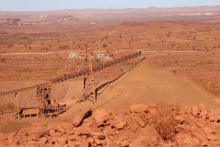
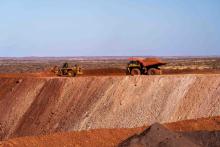
END of mine life has become an increasingly important consideration for miners worldwide.
Strewn across the Western Australian landscape are plenty of examples that speak to the magnitude of the task.
The abandoned gold stopes pockmarking the Goldfields, the deadly mess left by CSR at Wittenoom, and BHP’s mothballed Mount Goldsworthy iron ore mine are just a few.
A desire by native title holders to see country returned to its pre-mining state, among other factors, has been key to a more concerted effort to restore environments.
Businesses specialising in rehabilitation include Warmun-based MDM Mining & Civil and majority Kariyarra-owned outfit Buru Rehab.
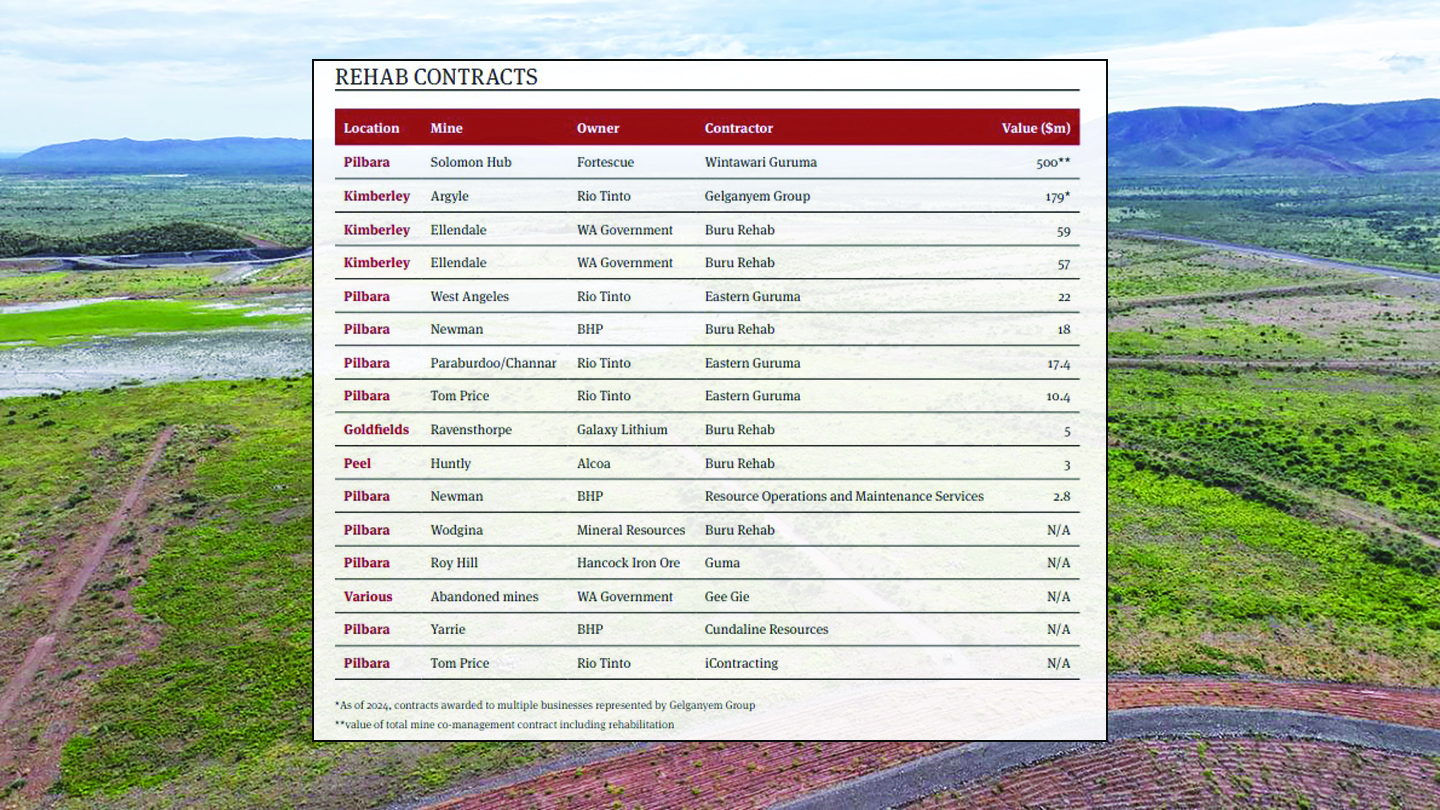
Most of the major Indigenous contractors undertake remediation work either as part of broader contracts with the state’s mining giants, or as standalone work packages.
Examples include Eastern Guruma’s deals with Rio Tinto, and the Taylor family’s Cundaline Resources’ work at Yarrie for BHP.
The contracts awarded to date have generally run for between two and five years, offering long-term training and jobs on country.
Of course, it is not all rosy.
Navigating differing priorities between stakeholders – the economic imperative of miners and the cultural obligations of traditional owners – has led to friction at times.
A group in the remote northeastern corner of the state has been at the coalface of this issue.
The deep end
Mine closure has proven a steep learning curve for the traditional owners of the east Kimberley.
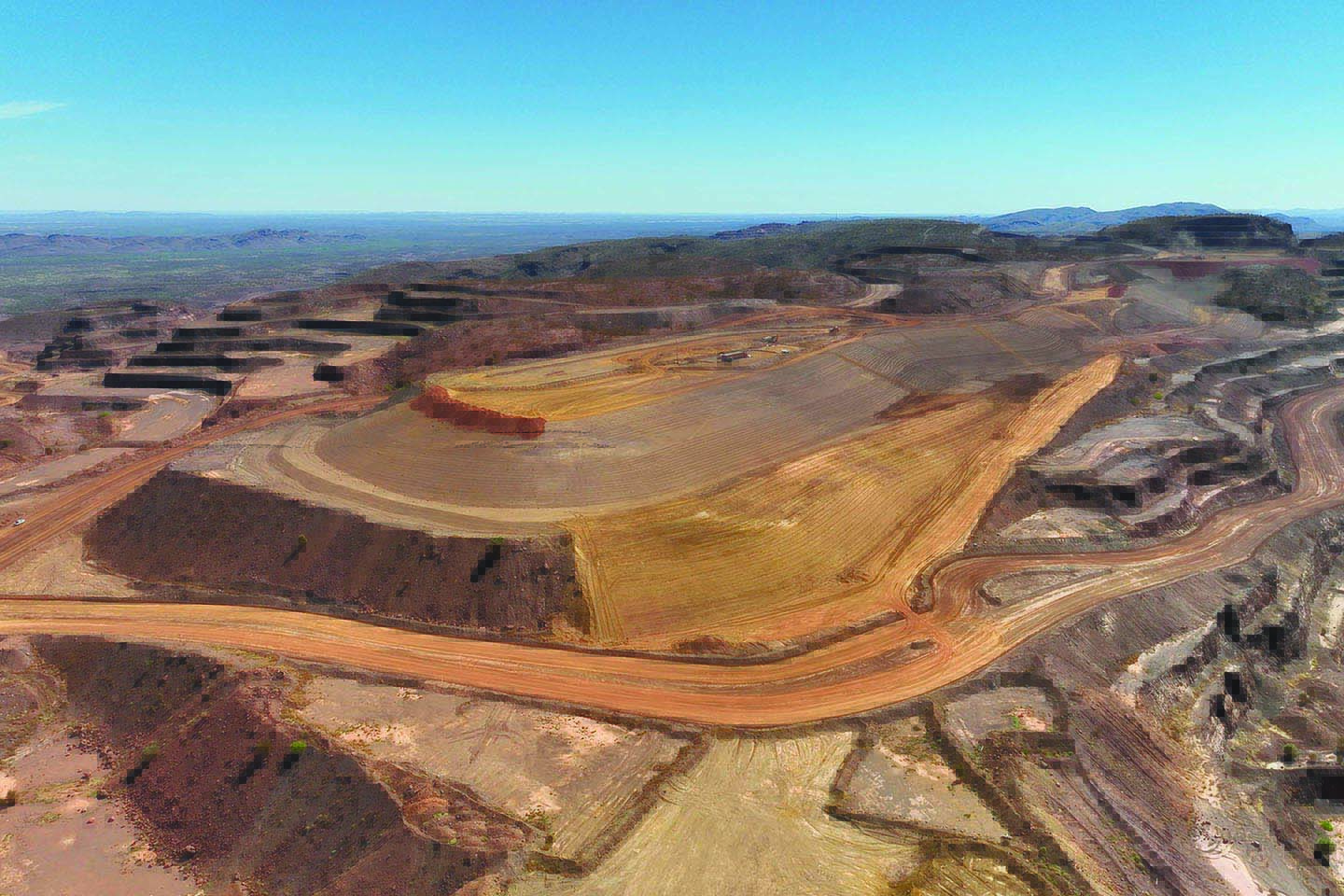
In 2020, Rio Tinto halted mining at the 43-year-old Argyle diamond mine, south of Lake Argyle and famous for its pink diamonds.
Rehabilitation of the remote site has been a point of equal parts pride and tension for the company and traditional owners.
Indigenous-owned business MDM Mining & Civil is leading the rehabilitation effort on the ground, while Gelganyem Group manages relations with Rio Tinto.
Gelganyem Group is the representative of the seven Indigenous family groups on whose land the mine is located.
The group’s chair and Gija woman, Kia Dowell, chief executive Dominique Reeves and mine closure general manager Jessica Welch unpacked lessons learned at a mining forum facilitated by the Cooperative Research Centre in April.
Key themes included prior planning, power imbalances, and the decision-making structure of mining company departments.
“In the Western governance system the expectation is that the authority [lies] with a general manager or a project director, or a project manager,” Ms Dowell said.
“That is quite a disrespectful framework when you have senior knowledge holders, people who have seen that country change over decades dealing with someone who’s there on average for 18 months.
“The chair of a mining company or the CEO of a mining company should expect to meet with cultural elders, not just the CEO of the organisation or the chair of the prescribed body corporate board.
“Not every traditional owner can speak for every part of country, and that hasn’t always landed and hasn’t always been heard.”
All three Gelganyem representatives were frustrated by their interactions with mining companies, where progress with one department was often not communicated internally with other departments.
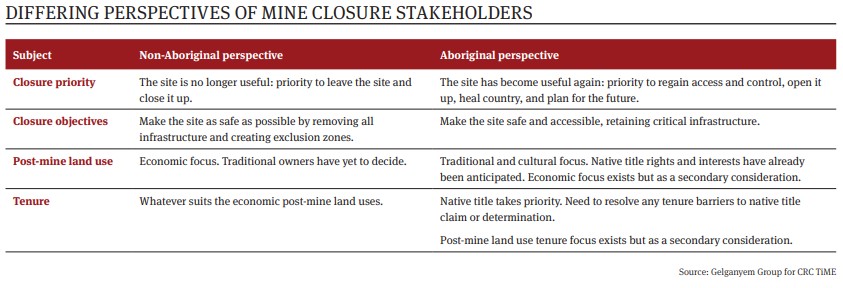
Ms Dowell said she felt progress had been made to address this during the Argyle closure process.
That sentiment was shared by Ms Reeves, who said miners and native title bodies were still in the early stages of determining how best to progress mine closure in the interests of both parties.
“From a First Nations point of view, they own the house and the land,” she said.
“The mining company is a tenant, it is there briefly, it does some stuff while it is there and then it leaves.
“As people work toward closure there needs to be a much stronger emphasis on the social impact the mining company leaving is going to have on the community.
“It is important to understand what the land was used for before, which is something the world is only just starting to grapple with.”
There are changes Gelganyem want to see: long-term monitoring post-closure, understanding cultural authority, and better recognition of closure obligations at the start of a project among them.
Ms Dowell sees Gelganyem’s experience as an opportunity to show the world how mine closure can be done.
“Our role is not dictated by the lifecycle of the mine,” she said.
“Our obligations were there before mining started and they will be there long after relinquishment.
“The industry itself largely sees closure as a technical, environmental and regulatory process.
“For traditional owners it is about understanding what we are handing on to our kids and their kids.
“We have tried really hard to uphold the values of humility, grace strength and understanding that if we don’t do this well together then we are collectively failing not just traditional owners, but the industry and our communities.”
Gelganyem mine site closure general manager Jessica Welch warned miners could experience far-reaching repercussions if no agreement was reached with communities on closure practices.
“Closure is the last thing the mining company will be remembered for,” she said.
“There is nothing more infuriating for a First Nations group than reading one thing, hearing something else, then living an entirely different experience.
“As a mining company there are always these big global promises being made.
Traditional owners see that, they read that, and often those are presented at the beginning of a relationship, so just remember them at the end.”
Big business
Construction and mining services firm Eastern Guruma is one of the largest Aboriginal-owned business actively working in mine site remediation.
The company was founded by Eastern Guruma woman Tania Stevens and Guruma woman Samantha Connors in 2004.
Today, it employs about 330 people, according to Data & Insights, primarily on contracts serving BHP, Rio Tinto and Fortescue’s Pilbara mining operations.
The company has three major rehabilitation contracts worth a combined $50 million at Rio Tinto’s Tom Price, Paraburdoo, Channar and West Angeles sites. Eastern Guruma Indigenous business development manager Chris Cowan said Aboriginal businesses were uniquely placed to deliver rehabilitation services.
“They combine cultural knowledge of country with proven operational capability and a long-term commitment to sustainable land outcomes,” he said.
“Many Indigenous contractors already successfully deliver large civil, mining and environmental services in remote regions, making rehabilitation a natural fit with our capabilities.
“In the Pilbara especially, strong local presence, understanding of culturally significant landscapes and fundamental interest in restoring land for future generations can improve rehabilitation outcomes.
“These types of projects, if done well, can create lasting employment, capability development and broader social value for traditional owners, communities, and Indigenous businesses.”
Like Gelganyem, an eye to economic empowerment and lasting benefit is key for traditional owner-led companies in the Pilbara.
Mr Cowan said continuous work and long contracts went some way to addressing these concerns.
“This creates the ability to purchase fleet, employ a permanent workforce and build efficiency and a performance culture that will deliver stronger outcomes for the client and the contractor,” he said.
Another interesting remediation case is Buru Rehab’s work on the Ellendale diamond mine east of Broome.
Rehabiliation work at the Argyle Diamond Mine. Photo: Rio Tinto
A mid-tier, two-thirds Aboriginal-owned outfit with 85 staff on the books, according to Data & Insights, about 60 per cent of Buru Rehab’s workforce are Indigenous.
Buru won the three-year, $59 million Ellendale contract from the state government in 2023, and a second, $57 million contract for two years in late 2025.
Work under the first package required rehabilitation of 207 hectares of disturbed land.
Stage two comprises a further 148ha.
It has all been funded through the WA government’s Mine Rehabilitation Fund because Ellendale’s former owner, Kimberley Diamonds, collapsed.
The shuttered mine is currently owned by ASX-listed Gibb River Diamonds.
In November 2025, Buru Rehab co-owner Ben Latimore told Business News the contracts had resulted in significant growth for the business.
“Central to our success has been our approach to Indigenous engagement,” Mr Latimore said.
“It is focused on genuine outcomes for traditional owners.
“It’s heavily tailored to what the local Indigenous people want and where they are in their journey.”
About 30 Indigenous people went through Buru’s training program at Ellendale.
Buru was founded in 2022 by Banjima-Kariyarra man George Todd, Biripi man Mr Latimore, from NSW, and mine rehabilitation professional Ray Gerrard.
Mr Todd founded Port Hedland machinery hire firm Buru Group in 2018.
In 2024, the company won an $18 million contract from BHP to rehabilitate exploration sites in the Pilbara over three years.
Buru’s other major North West deal is a five-year contract, won in 2024, to undertake mine service and remediation work at Mineral Resources’ Wodgina lithium mine.
In the south of the state, Buru has won a $5 million contract from Galaxy Lithium for its Ravensthorpe mine, and a $3 million deal from Alcoa to rehabilitate its Huntly site.