If your organisation invested in community programs last year, you could probably say how much you spent. Could you say what changed as a result?
Most Western Australian businesses are doing more for their communities than they can prove. Not because the work isn’t meaningful, but because the way it’s measured, or not measured, makes it nearly impossible to demonstrate.
Australia’s mandatory sustainability reporting obligations are now in effect for larger entities, with more organisations coming into scope through 2027. Boards and executive teams are accountable for these disclosures in a way they simply were not two years ago.
For many Western Australian businesses, the focus over recent years has been on environmental performance, governance frameworks, and preparing for increasing disclosure requirements. Through Naturaliste Solutions’ work supporting WA organisations through sustainability disclosure requirements, we see this consistently: the Environmental and Governance components of ESG have matured considerably.
The Social component has not.
As sustainability expectations mature, that distinction is increasingly influencing procurement decisions, social licence to operate, and the ability to attract long-term investment, particularly in WA’s resources and infrastructure sectors.
In practice, this creates a challenge for many businesses. Community investment often sits outside the governance structures used to manage environmental performance or operational risk. As a result, social initiatives are frequently evaluated through anecdote and goodwill rather than evidence, measurement, and long-term outcomes. For businesses operating in the resources sector, where procurement and investment decisions increasingly require credible ESG evidence, this gap is becoming harder to ignore.
Consider the issue of workforce participation
Western Australia continues to face workforce pressures across resources, infrastructure, energy, construction, health, and regional industries. Much of the public discussion focuses on skilled migration, training pathways, housing, and productivity. These are important issues.
However, there is another workforce challenge that receives far less attention.
Every year, approximately 125 Western Australian children are diagnosed with cancer. Many experience prolonged disruption to their education during treatment and recovery. Without structured support, educational disengagement can continue long after medical treatment has ended, affecting future participation in employment, training, and community life. This is not a metropolitan issue. The Pilbara, Kimberley, Goldfields, Midwest, and Great Southern are all regions where Back on Track Foundation currently operates, and the same regions where WA’s major industries depend on local workforce participation and community social licence.
For businesses focused on long-term workforce resilience, this matters.
The future workforce is not created when an individual enters the labour market. It is shaped years earlier through educational participation, community connection, confidence, and opportunity.
This is where the Social component of ESG becomes more than a reporting exercise.
What measurable social investment actually looks like
The most effective social investments are not necessarily those that generate the greatest visibility. They are the investments that address meaningful social challenges while producing measurable outcomes over time.
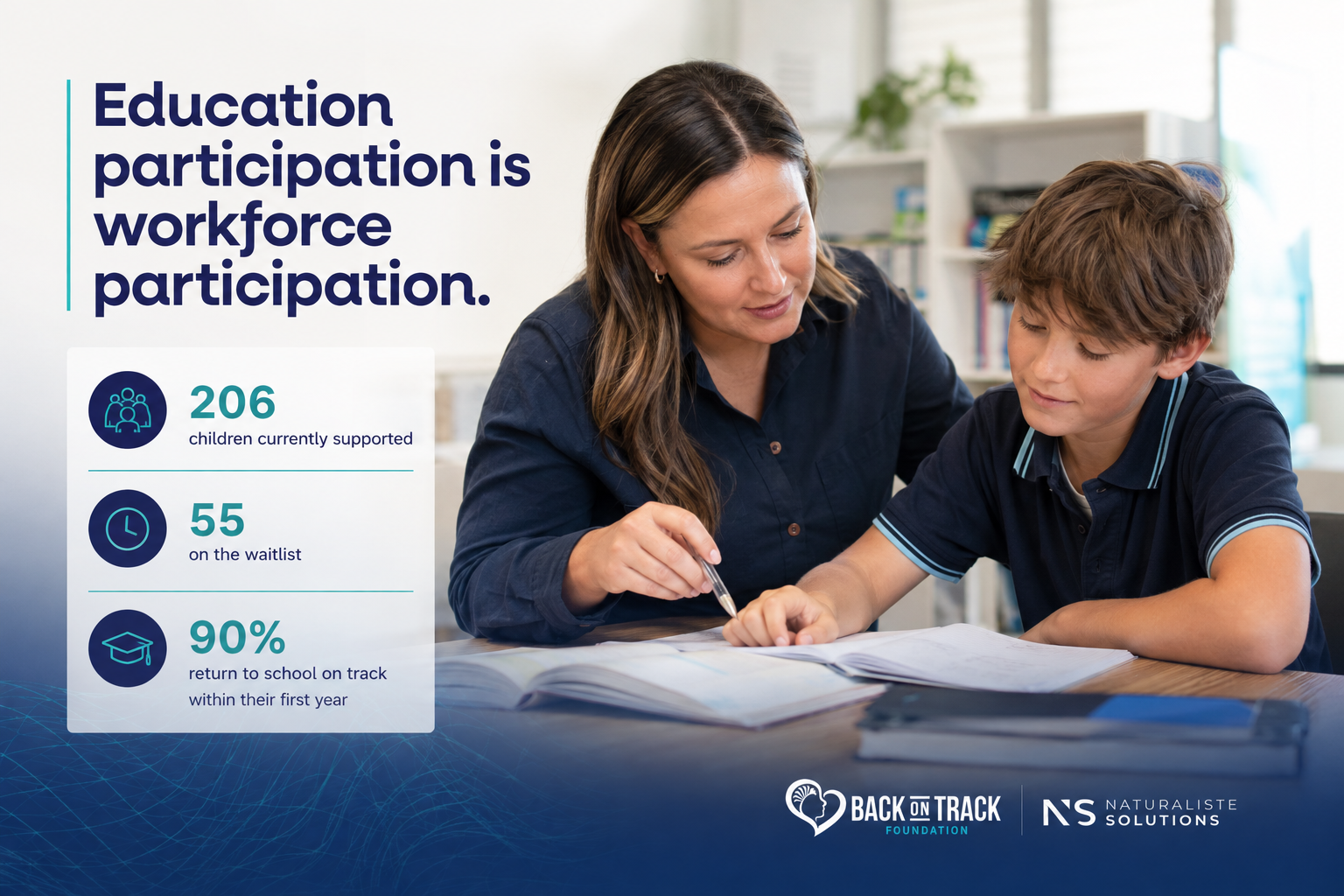
Back on Track Foundation's SSRA corporate partnership program provides an example of this approach in practice. The program delivers up to 40 weeks of one-on-one trauma-informed educational support each year for children recovering from cancer and other serious illnesses. Currently supporting 206 children across metropolitan and regional Western Australia, with 55 more on the waitlist, the program tracks outcomes through educational engagement, attendance, academic progression, and successful reintegration into school.
Ninety per cent of supported students return to school on track within their first year of support.
For businesses, this creates something that is often missing from community investment programs: measurable social return that can be tracked, reported, and built upon year on year. That is the distinction between community investment that appears in a footnote and community investment that meaningfully contributes to an organisation’s ESG narrative.
Why social impact without governance is no longer enough
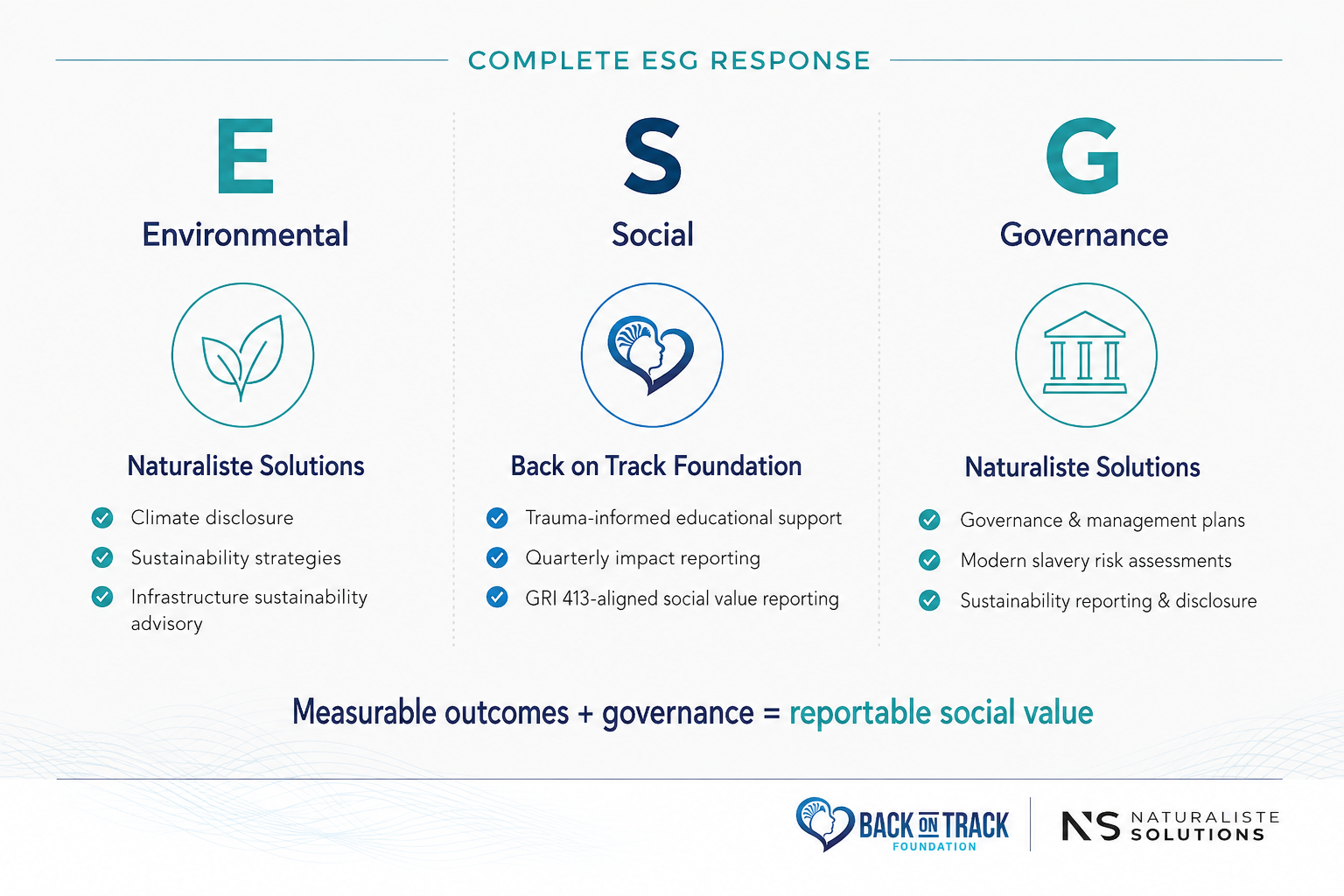
Measurable outcomes alone are not enough. Organisations also need governance structures that allow those outcomes to be incorporated into sustainability reporting, procurement frameworks, stakeholder engagement strategies, and broader ESG objectives.
Naturaliste Solutions works with WA organisations to build the governance architecture that makes social investment reportable translating community outcomes into sustainability disclosures that can withstand board scrutiny, procurement assessment, and stakeholder expectations. Back on Track Foundation delivers the measurable community impact that sits at the heart of that framework. Together, we offer something neither organisation can provide alone: a locally grounded ESG solution with both the reporting architecture and the real-world outcomes to support it.
The Social component of ESG should not be viewed solely as philanthropy, sponsorship, or compliance. At its best, it represents an opportunity to create measurable value for both communities and businesses.
Organisations that can demonstrate genuine social impact supported by credible governance and measurable outcomes will be better positioned to meet stakeholder expectations and strengthen their social licence to operate.
The future of sustainability is not simply about reporting what organisations do.
It is about demonstrating the value they create.
That is where sustainability meets social return.
To explore how the SSRA partnership works for your organisation, contact Rebecah Ettridge at rebecah@naturalistesolutions.com.au or Kylie Dalton at kylie@backontrack.org.au.
Back on Track Foundation is a registered ACNC charity with DGR1 status. All donations are fully tax-deductible. SSRA structures are subject to the customer’s procurement rules and contract terms.