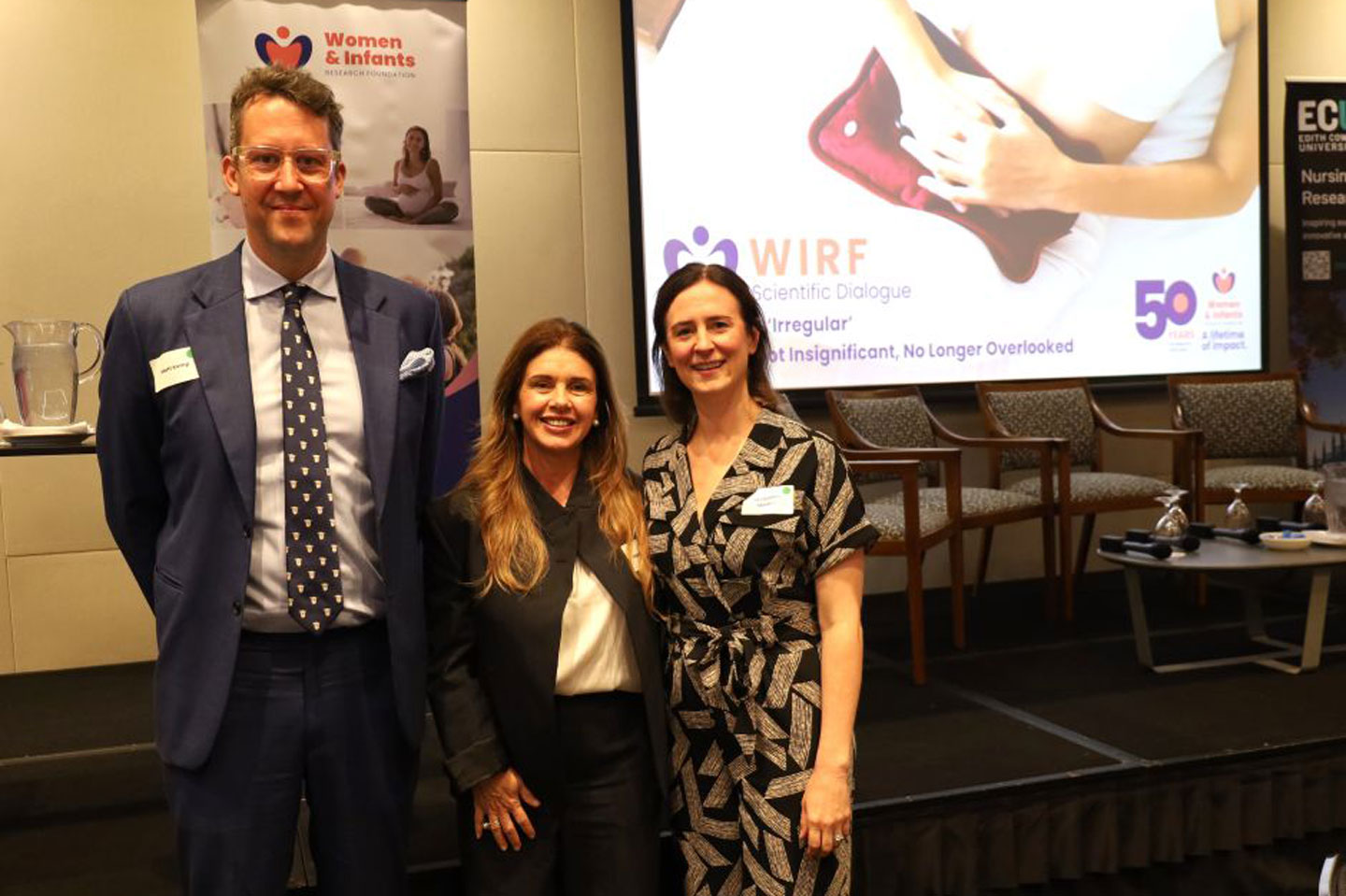
Last week, the Women and Infants Research Foundation welcomed leading UK clinician-scientist Dr Jacqueline Maybin to Perth, where she spoke about the overlooked toll heavy menstrual bleeding takes on women’s health, work and everyday lives.
Speaking at WIRF’s 2026 Scientific Dialogue at the University Club of Western Australia, Dr Maybin, from the University of Edinburgh's Centre for Reproductive Health, delivered a powerful message: heavy menstrual bleeding is common, debilitating and too often dismissed as something women must simply endure.
The consequences extend far beyond women’s health. Research involving 1,796 Australian working women estimates that period pain and heavy menstrual bleeding cost the national economy about $14 billion every year in lost productivity.
Women experiencing heavy menstrual bleeding may continue working while managing pain, sleep disruption, significant blood loss and iron deficiency. Some plan their days around access to bathrooms or carry spare clothing in case they bleed through what they are wearing.
Others miss work, education and professional opportunities altogether. “Despite this affecting up to one in three women of reproductive age, heavy menstrual bleeding remains under-reported and under-recognised,” Dr Maybin said.
“Women are not functioning at their best. We need to address it and have robust ways of identifying heavy menstrual bleeding.”
The economic burden is driven not only by absenteeism, but also by presenteeism: women continuing to work while their symptoms reduce their energy, concentration and capacity to perform.
This is not a marginal health complaint. It is a widespread workforce issue hiding in plain sight.
Held under the theme Reframing ‘Irregular’: Not Rare, Not Insignificant, No Longer Overlooked, the Scientific Dialogue brought together clinicians, leading investigators and emerging researchers to examine abnormal menstrual bleeding and other significant challenges in women’s reproductive health.
Dr Maybin is a specialist in heavy menstrual bleeding and runs a menstrual disorders service offering medical and surgical treatments. She also leads Wellcome Leap’s The Missed Vital Sign, a three-year global research program seeking to transform how abnormal menstrual bleeding is identified, diagnosed and treated.
The program aims to bring multidisciplinary teams together to achieve breakthroughs in years rather than decades.
A major focus is developing more accessible and reliable ways to measure menstrual bleeding. Without robust methods of quantification, women may not recognise that their experience is abnormal, while healthcare professionals may lack the information needed to diagnose the condition early.
“We need good diagnostics and good treatments,” Dr Maybin said.
“We are working on quantification methods that we want to become the norm, so healthcare professionals can better identify women experiencing heavy menstrual bleeding.”
Normalisation remains one of the greatest barriers.
Heavy periods can run in families, leading girls to believe significant bleeding is normal because their mothers or grandmothers experienced similar symptoms. Instead of recognising a possible health issue, they learn how to manage and conceal it.
“Normalisation within families is one of the reasons it is not talked about,” Dr Maybin said.
“Menstruation remains an unspoken topic because of the societal taboo around it, and sometimes women’s experiences are dismissed.”
Women can become highly skilled at carrying on, but carrying on is not the same as being well.
If another part of the body were bleeding heavily and repeatedly, it would prompt urgent concern. Menstrual bleeding, however, is rarely measured or recorded with the same clinical urgency as blood pressure, temperature or heart rate.
That is why it has been described as the “missed vital sign”.
Dr Maybin imagines a health system in which women receive support after experiencing only a small number of unusually heavy periods not after years of managing the condition alone.
“I imagine a world where a woman may have two or three heavy periods, but not 60, before the problem is identified and she receives help,” she said.
Achieving that will require better diagnostic tools, stronger clinical awareness and more personalised treatments.
Some women cannot use hormonal therapies, experience side effects or want an alternative.
“There are good treatment options available, but there is still a gap for women who want or need alternative methods,” Dr Maybin said.
“We need accessible, convenient and specific treatments that can be personalised for individual women.”
Workplace flexibility and supportive policies have an important role, but policy alone will not change health outcomes. Australia must also invest in earlier identification, accurate diagnosis and a wider range of effective treatments.
Research must also be guided by the people it is intended to help.
Dr Maybin’s latest research, published in The Lancet Obstetrics, Gynaecology & Women’s Health, identified the top 10 research priorities for problematic menstrual bleeding in the UK.
Importantly, those priorities were not selected by researchers alone. Women with lived experience and healthcare professionals helped identify the unanswered questions that mattered most to them.
“We cannot do research for women without doing it with women,” Dr Maybin said.
That message was reinforced by a significant funding announcement during the Scientific Dialogue.
On the night, WIRF awarded $500,000 through its Research Acceleration Awards to support 10 innovative projects tackling critical health challenges affecting women and babies.
The projects span maternal and pregnancy health, newborn care, cancer research, precision medicine and intergenerational health from gestational diabetes and fetal development to ovarian cancer and neonatal care.
Two PhD Student Travel Awards were also presented to help early-career researchers share their work nationally and internationally, build professional networks and connect with leaders in their fields.
WIRF chief scientist Professor Matt Kemp congratulated the recipients on the strength, ambition and potential impact of their projects.
“Research has the power to change the trajectory of a person’s health, but promising ideas need investment to move from possibility to impact,” Professor Kemp said.
“Our 2026 Research Acceleration Awards are supporting researchers with bold ideas that address some of the most important challenges in women’s, maternal and newborn health.”
The investment will support better clinical care while strengthening WA’s research capability and developing its next generation of scientists.
If we get women’s health right, we get it right for everyone, for mothers, sisters, partners, daughters and an economy that depends on their participation.


 By Hearts and Minds