The Reserve Bank of Australia has just released its revised economic outlook, following this month’s rate hike that lifted the cash rate to 4.35 per cent.
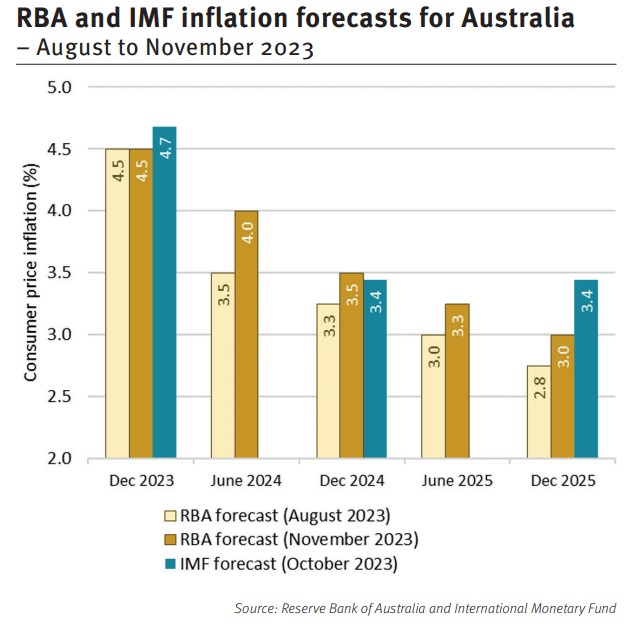
The RBA is now projecting higher inflation until the end of 2025 compared to its previous forecast in August.
Annual price inflation is now expected to peak at around 4.5 per cent at the end of this year before declining gradually to about 3 per cent – the top end of the RBA target range – by the end of 2025.
The International Monetary Fund expects high inflation in Australia to endure for longer.
In its latest World Economic Outlook, the IMF forecasts consumer price inflation growth in Australia to remain at 3.4 per cent in December 2025.
By whatever benchmark, we can expect more pain to come for borrowers, with interest rates remaining high for at least the next two years.
But why are prices in Australia proving to be so resistant to cash rate increases by the RBA?
Inflation targeting is a central tenet of monetary policy across the world, yet the underlying inflation rate in Australia stubbornly refuses to respond.
Part of the story comes from the drivers of price inflation.
The effectiveness of monetary tightening in reducing inflation depends on whether the driving forces for inflationary pressures are on the demand side or supply side.
History shows that interest rate increases are an effective means to contain inflationary pressures if inflation is caused by an increase in demand in the economy.
Lifting the cash rate is intended to take heat out of the economy by increasing the cost of borrowing (and the returns to savings) and reducing consumers’ purchasing power.
As a rule, supply side shocks have tended to be regarded as temporary in nature. This has meant that demand-driven monetary policy has been able to weather the storm of supply-driven factors.
The problems for most economies around the world are twofold, however.
First, supply-side factors such as geopolitical risk and global energy price shocks have endured to an unprecedented degree from a succession of supply-side shocks over at least the past 18 months.
And second, the influence of these supply-side factors has grown over time and they now account for the majority of Australia’s consumer price inflation.
For example, fuel prices increased by 7.2 per cent in the last quarter and were the dominant factor behind the 1.2 per cent increase in overall consumer price inflation over the September quarter.
Treasurer Jim Chalmers stated that the main reason for the recent increase in inflation is the surge in fuel prices and warned that prices could rise further amidst conflict between Israel and Hamas in the oil-rich Middle East region.
This is a typical example of a supply-side shock that fuels inflation, but which cannot be mitigated by rate hikes.
The danger of using interest rates to contain inflation driven by supply shocks is that it can create a situation of high inflation combined with rising unemployment: a phenomenon termed ‘stagflation’ by economists.
This was the policy mistake in 1989 when the RBA increased interest rates quickly to tackle the supply-push inflation caused by Australia’s current account deficit at the time, but which pushed the national economy to recession in the following years.
History may repeat itself if a rate hike is used to fight supply-push inflation driven by external shocks and geopolitical challenges such as the Russia-Ukraine and Israel-Hamas conflicts.
The International Monetary Fund has advised that reducing structural deficits and boosting productivity growth should be key government policy priorities in the fight against inflation.
Using the cash rate as the single policy instrument to control inflation could cause more damage than good.
- Dr Abebe Hailemariam is a Research Fellow with the Bankwest Economics Centre