Almost two in five Australian women aged 18 and over have experienced physical and/or sexual violence since the age of 15. Behind that statistic are employees, colleagues, clients, customers, friends and family members.
Violence against women is not separate from the workplace. It can affect connection, safety, wellbeing, financial security and participation at work. For some, work may provide stability and a pathway to support. Workplaces have two roles. They can help prevent violence by creating cultures built on equality and respect, while ensuring employees affected by violence receive a safe, informed and compassionate response. Workplaces are more than places of employment.
They are communities where expectations are set, behaviours are reinforced and people learn what will be accepted, challenged or ignored. Every workplace has a responsibility to ensure staff feel safe, respected and supported. Policies, values and workplace charters matter, but culture is shaped by action. It is seen in leaders’ standards, managers’ responses and whether employees feel confident speaking up when harmful behaviour occurs. We can picture our response to violence against women as a hill.
As a community, we are standing at the top looking down. At the bottom is the ambulance service, representing crisis services, police, courts, emergency accommodation and specialist support after harm has occurred. That ambulance service is essential and must be funded and ready to respond. At the peak is the fence. It represents primary prevention: addressing the attitudes, behaviours and social conditions that allow violence against women to occur. Along the slope are points where people can recognise red flags, intercede and connect someone with support.
Spotting disrespect, control, coercion and other warning signs creates opportunities to step in early, challenge what is happening and help change behaviour before it becomes entrenched or escalates. Further down are specialist behaviour change programs, legal and housing assistance, crisis responses, recovery services and ongoing support for victim survivors.
Building the fence does not mean removing the ambulance. Every point on the slope must be funded, connected and supported. Governments, businesses, services, communities and individuals each have a role. No organisation, sector or program can carry the responsibility alone.
Every Australian needs to understand where they stand on the slope and what they can do. People need the knowledge to recognise harmful attitudes and behaviours, the confidence to respond and the courage to act safely. They should feel supported to speak up, intercede or seek help.
Workplaces can provide that support through clear expectations, practical education and trusted pathways. For organisations ready to make a commitment, White Ribbon Australia’s Workplace Accreditation provides a framework for embedding prevention and appropriate responses across leadership, culture, governance and policy. Accreditation helps organisations recognise strengths, identify gaps and strengthen accountability. It equips staff and managers to challenge harmful behaviour, recognise signs of abuse, respond appropriately to disclosures and connect employees with workplace and specialist support. Accreditation does not need to be the first step.
Organisations that are not ready for the full program can begin with White Ribbon Australia Workplace Training or a You Can Ask That (YCAT) session.
Training builds skills to recognise and respond to family and domestic violence, while YCAT creates a space to explore respect, gender equality, harassment and abuse. Both can start important conversations and build confidence for further action. Every employee is part of a family, sporting club or community. Conversations and behaviours encouraged at work can influence how people treat one another beyond office walls. Action will look different in a mining company, construction business, bank or family-owned enterprise, but the responsibility is shared.
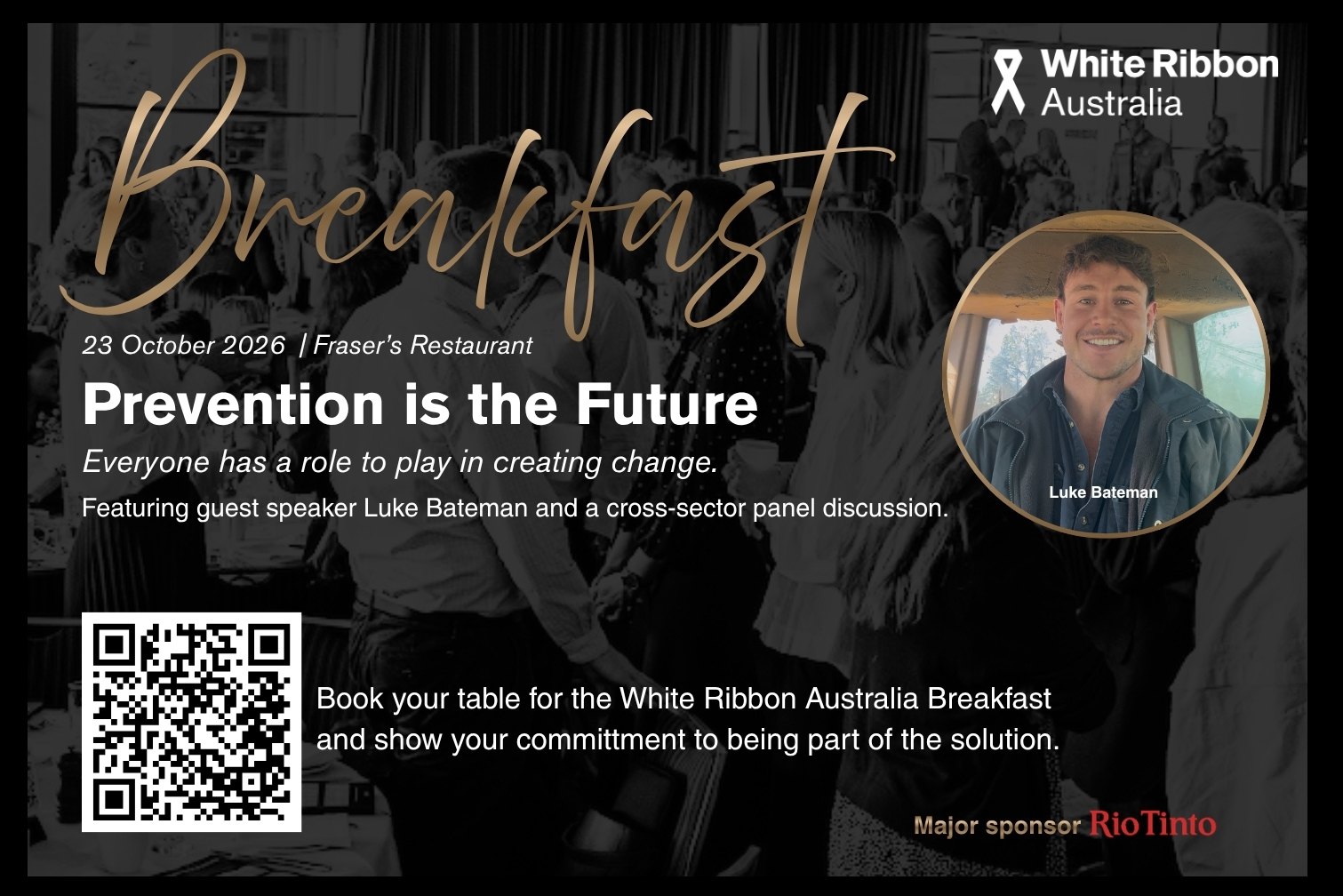
On 23 October, the White Ribbon Australia Breakfast will bring business and community leaders to explore the theme, Prevention is the Future. Everyone Has a Role in Creating Change. Featuring former NRL player Luke Bateman and a cross-sector panel, the Breakfast will examine what prevention looks like in practice, how workplaces can support their people and why every point on the slope needs investment and action.
Bring your team, learn from organisations taking action and consider where your workplace sits on the slope and what it can do next. Book your table for the White Ribbon Australia Breakfast on 23 October and join leaders committed to creating safer, more respectful workplaces and communities.
Book your table today.
https://events.humanitix.com/white-ribbon-australia-breakfast


 By Hearts and Minds