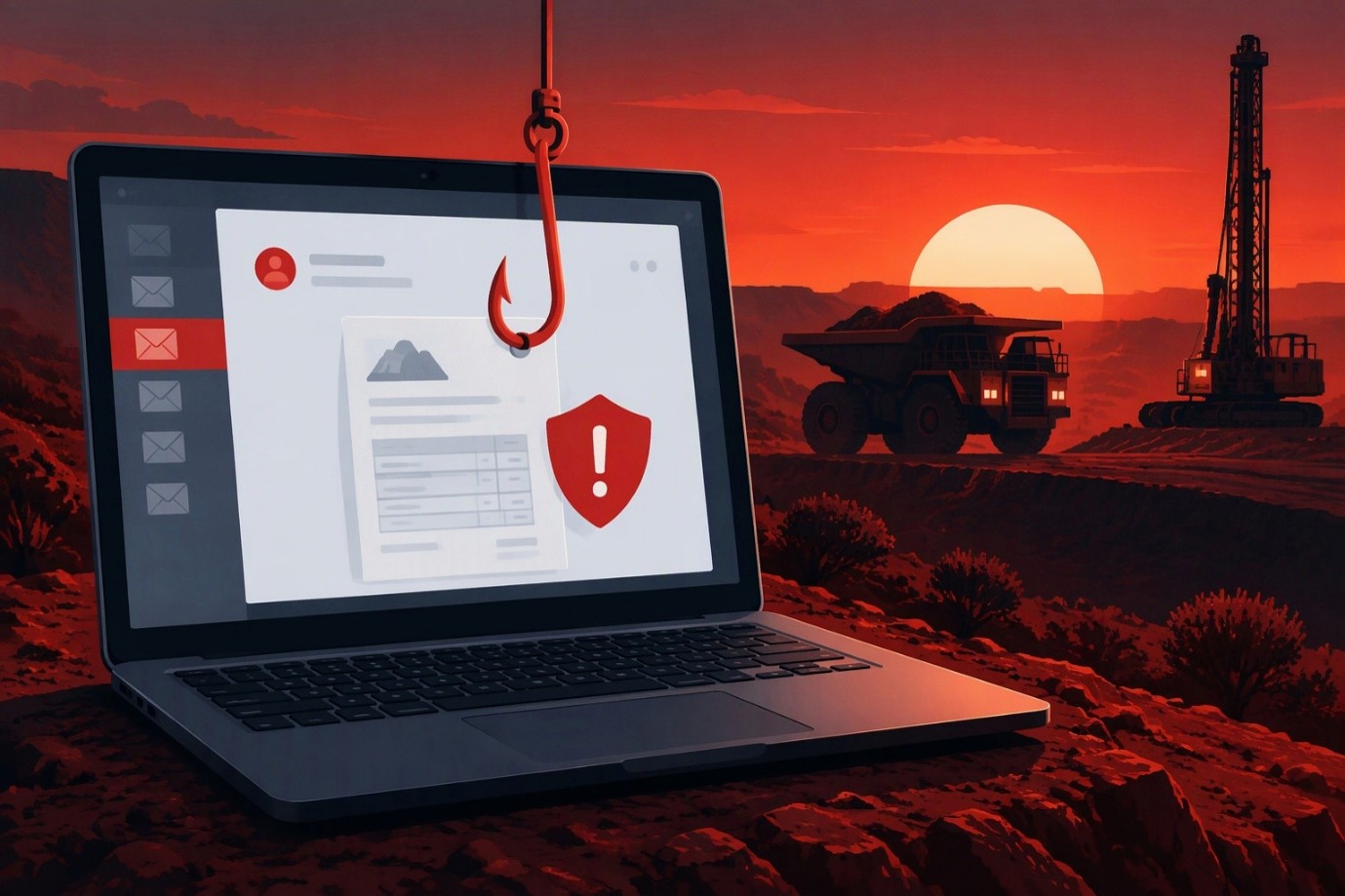
Every week, accounts teams across Western Australia process hundreds of invoices from drillers, surveyors, fuel suppliers, camp operators, geologists and equipment hire companies. Most of them are perfectly genuine. A small number are not, and those few are the ones that can cost a business tens or even hundreds of thousands of dollars in a single afternoon.
The scam usually arrives as a polite, ordinary looking email: "Hi, we have recently changed banks. Please use the new account details below for all future payments." It looks like your supplier. It reads like your supplier. It might even sit inside a genuine email thread. But the money goes straight to a criminal, and by the time anyone notices, it has usually been moved on.
Why mining and mining services businesses are such attractive targets
Scammers go where the money moves, and the resources sector moves a lot of it. Contracts are large, supply chains are long, and payments often flow between many parties across remote sites, Perth head offices and overseas suppliers. Add tight project deadlines and small finance teams, and you have exactly the kind of environment where a convincing request can slip through.
Junior explorers are particularly exposed. A lean team might have one person handling accounts, a director approving payments from the field, and consultants and contractors who change over from one program to the next. When a new payee appears or a bank detail changes, there is rarely a long history to compare it against. That is precisely what a scammer is counting on.
How an invoice scam actually unfolds
These attacks, often called business email compromise, are rarely random. The criminals do their homework, and they tend to follow a familiar pattern.
Step one: they get access. Sometimes a supplier's email account is compromised through a stolen password. Other times it is your own mailbox. Once inside, the attacker simply watches. They read about upcoming payments, learn how your people talk to each other and wait for the right moment.
Step two: they slip into the conversation. Using the real account, or a lookalike address with one letter changed, they send a message that fits neatly into an existing thread. The invoice amount is right. The reference number is right. Only the bank details are different.
Step three: they add pressure. You will often see urgency, such as a payment that is overdue, a mobilisation that cannot proceed or a director who needs this sorted before a flight. Urgency is the scammer's best friend because it discourages the very checks that would expose them.
Step four: the money disappears. Because bank transfers are fast and hard to reverse, recovery is difficult. Prompt action with your bank can sometimes help, but it is never guaranteed.
It is not only about invoices
The same tricks show up in other forms. Text messages claiming to be from Australia Post, a toll operator or a freight company ask staff to click a link and "pay a small redelivery fee". Those links can steal passwords or card details, and a stolen password on a work phone can open the door to the email account that sits behind your invoices. Staff in site offices and exploration camps are just as likely to receive these as anyone in a Perth office, often while they are busy and on their phones.
Payroll is another favourite. A message that appears to come from a team member asks for their super or bank details to be updated before the next pay run. It is the same con with a different costume.
A simple checklist that stops most of these scams
The good news is that you do not need expensive technology to stop the most common version of this scam. You need a consistent habit. Here is the checklist we recommend to our clients.
- Never change a payee's bank details based on an email alone. No matter how genuine it looks, an email is not proof.
- Ring back on a number you already hold. Use the number in your accounts system or on a previous signed contract, not the number in the email or on the new invoice.
- Speak to a person you know. Confirm the change with someone you have dealt with before, and ask them to confirm the old and new account details.
- Get a second set of eyes. Require a second person to approve any new payee or changed bank detail, and keep the approver separate from the person entering the payment.
- Check the sender carefully. Look at the full email address, not just the display name. Watch for lookalike domains, such as a swapped letter or an extra word.
- Treat urgency as a warning sign. The more pressure there is to skip the process, the more important the process becomes.
- Make a small test payment for large changes. For significant amounts, send a small amount first and confirm receipt with the supplier before sending the rest.
- Report it fast. If something feels wrong, or a payment has already gone out, call your bank and your IT provider straight away. Minutes matter.
Write this down, put it in your finance procedures and make sure everyone, including directors and site administrators, follows it. The rule only works if there are no exceptions for the boss.
Back up the process with the right technology
A good process is your first line of defence, but technology gives you a valuable safety net. A few controls make a real difference.
Multi-factor authentication on every email account. This is the single most effective step for stopping criminals from getting into a mailbox with a stolen password. It should be switched on for every user, including directors, contractors and part-time staff.
Email filtering and domain protection. Modern filtering catches many lookalike domains and spoofed messages before they land in an inbox, and settings such as SPF, DKIM and DMARC make it harder for criminals to pretend to be your business.
Monitoring for suspicious activity. Logins from unusual locations, new forwarding rules and unexpected mailbox changes are often the first signs of a compromise. Someone needs to be watching for them, ideally around the clock. This is where managed security services earn their keep, because the alerts are reviewed and acted on rather than left sitting in a console.
Staff awareness training. People are your best detection system when they are properly prepared. Short, regular sessions and simulated phishing emails help teams recognise the signs without turning security into a chore.
If you want to be able to show clients, insurers and project partners that your security is more than talk, it is also worth looking at a recognised standard. Qbit is SMB1001 Gold certified and helps businesses work towards the standard in a practical, staged way.
What to do if you think you have been caught
Do not panic, and do not delay. Contact your bank immediately and ask whether the payment can be recalled. Tell your IT provider so they can check the mailbox for unusual rules, reset passwords and look for other affected accounts. Let the supplier know through a trusted channel, because their email may also be compromised. Then report the incident through ReportCyber, which is run by the Australian Cyber Security Centre. Finally, review what happened with your team without blame. Every near miss is a chance to tighten the process.
A culture that makes it easy to say "let me check"
The best protection is a workplace where nobody feels silly for pausing a payment to verify it. Scammers rely on people being too busy, too polite or too worried about annoying a senior person. Make it clear that a quick call is expected, not an inconvenience. A 30 second phone call is a very small price compared with a lost payment.
How Qbit can help
Qbit IT Solutions is a Western Australian owned IT company that has looked after more than 300 local businesses since 2006, including many in mining and resources. We understand the realities of remote sites, lean head office teams and the need for systems that keep working when you are a long way from the city. Our team can review your email security, switch on the protections that matter and help your people spot the warning signs.
If you would like to know where your business stands, book a free IT assessment with our friendly team. We will walk you through the quick wins in plain English, with no jargon and no obligation.
This article was written by Fabio Suffell, Director, Qbit IT Solutions.